
How to Identify High-Value Buyers Using a Brazil Customs Import Database?
 Import News
 2025-12-26
Brazil is the largest economy in South America and a critical destination for global trade. However, its complex regulatory environment and high import tariffs make market entry challenging without the right information. Accessing a Brazil customs import database is the most effective way to demystify this market, identify key buyers, and ensure compliance.
Whether you are a manufacturer looking for new clients or a market researcher analyzing trade flows, understanding how to utilize these databases is essential.

1. What is the Brazil Customs Import Database?
In Brazil, official trade data is managed by the government through systems like SISCOMEX (Integrated Foreign Trade System). For public statistical use, the Ministry of Development, Industry, Trade, and Services provides Comex Stat, which offers high-level statistics on goods entering and leaving the country.
While government portals provide macroscopic data, businesses often require "line-level" details—such as specific company names, transaction values, and shipment frequencies—to make commercial decisions.
2. Key Features of Brazil Import Data
A comprehensive Brazil customs import database typically includes several critical fields that help businesses profile the market:
· Importer Details: The names and tax IDs (CNPJ) of the Brazilian companies purchasing the goods.
· Product Specifications: Detailed descriptions and NCM Codes (Nomenclatura Comum do Mercosul), which are the regional equivalent of HS Codes.
· Logistics Info: Ports of entry (like Santos or Rio de Janeiro), mode of transport, and country of origin.
· Financial Data: FOB (Free on Board) and CIF (Cost, Insurance, and Freight) values, as well as quantities and unit prices.
3. Top Tools to Access Brazil Trade Insights
· Tendata Import Export Provider
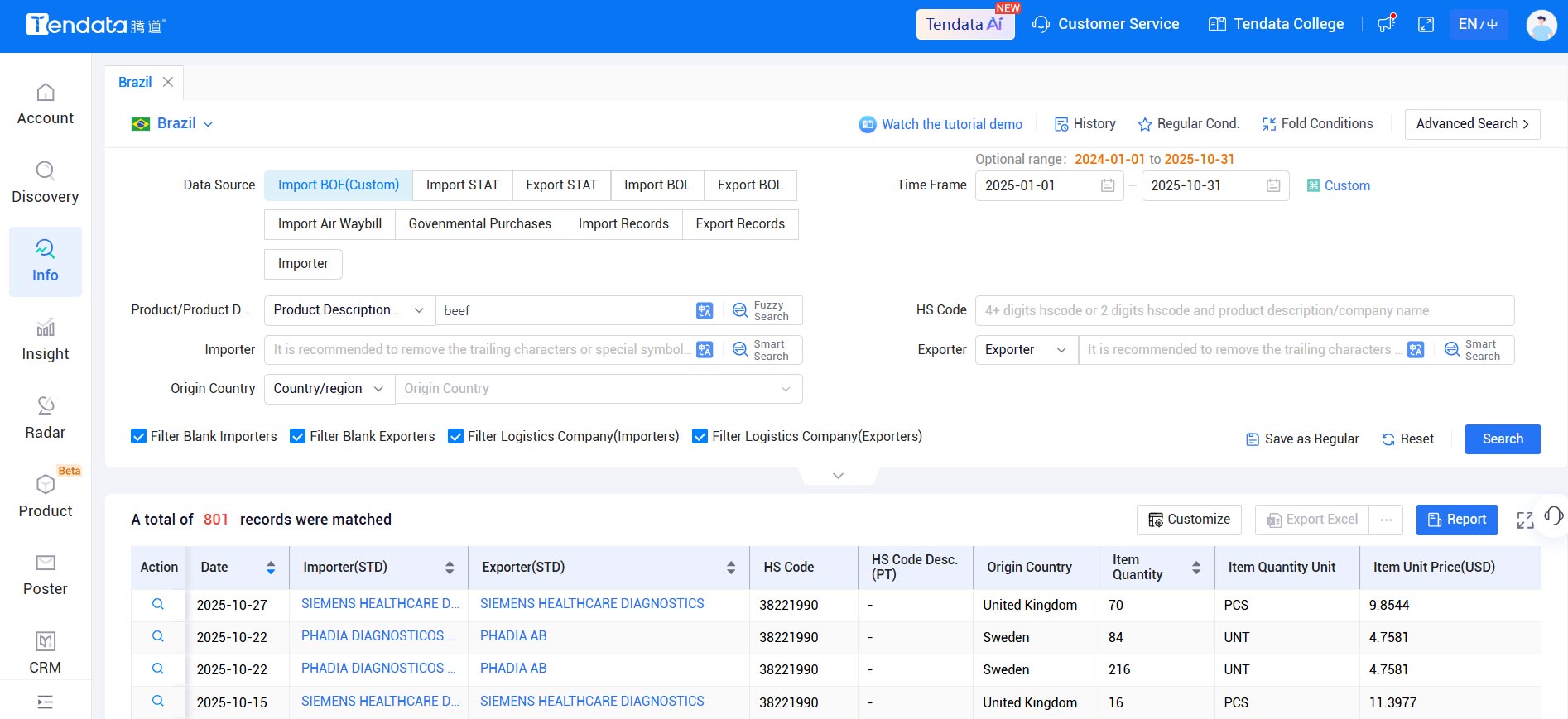
For businesses that need more than just statistics, the Tendata Import Export Provider is a leading commercial solution. It aggregates data from customs records and shipping manifests to provide a searchable, user-friendly interface.
Why use it? Tendata allows you to perform competitor analysis by seeing exactly which suppliers your rivals are using in Brazil. It also provides verified contact information for decision-makers at importing firms, which is rarely available in government-only databases.
· Comex Stat (Official)
This is the official government portal for trade statistics. It is excellent for identifying which product categories are growing in Brazil but lacks the granular "company-to-company" transaction data that sales teams usually need.
· Siscomex / Portal Único
This is the operational system used by Brazilian importers to register their DUIMP (Single Import Declaration). While it is a regulatory tool rather than a public search engine, understanding its data structure is vital for anyone handling the legal side of Brazilian imports.
4. How to Use the Data for Business Growth
· Identify High-Volume Buyers: Filter the database by volume and frequency to find the most stable partners in Brazil.
· Monitor Competitors: Track the shipment volumes of other international exporters to see if they are gaining or losing market share.
· Optimize Pricing: By analyzing the CIF values of similar products, you can adjust your pricing strategy to remain competitive within the Brazilian market.
· Reduce Risk: Verify the transaction history of a potential partner to ensure they have a consistent track record of customs clearance.
Category
Leave Message for Demo Request or Questions