
Top Global Oil Imports by Country & Company & Products-Tendata
 Import News
 2026-03-31
Keypoints
·Massive Market Scale with Strategic Importance
The global oil import market reached approximately $741.72 billion, involving 155,812 importers across 179 countries and over 5.33 million transactions, highlighting its role as a cornerstone of global trade and energy supply systems. Insights from oil imports by country further reveal how demand is distributed across major economies and emerging markets.
·Highly Concentrated Demand Structure
Despite broad participation, oil imports by country show that demand is dominated by a few major economies (e.g., India), while emerging markets such as Brazil, Pakistan, and Vietnam are rapidly increasing their share, reflecting shifting global demand patterns.
·Diverse Product Structure Across Value Chains
The oil import category includes crude oil, refined fuels (jet fuel, medium oils), and vegetable oils (soybean, palm, sunflower), indicating a dual structure serving both energy and food industries. Analysis of oil imports by country also highlights how different regions prioritize specific product categories based on industrial needs and consumption patterns.

Overview of the Global Oil Import Market
The global oil import market plays a vital role in supporting energy supply, industrial production, transportation, and food processing worldwide. From crude petroleum and refined fuels to essential vegetable oils, oil imports are fundamental to both economic development and daily consumption. As global demand continues to rise, oil trade remains a key driver of international commerce and supply chain stability.
Understanding oil imports by country, along with the top oil importing countries, major HS codes, and trade flow patterns, provides valuable insights into market demand, pricing dynamics, and sourcing strategies. This blog explores the global oil import landscape based on trade data, highlighting leading importing countries, key product categories, oil imports by country, oil import data trends, and other critical insights shaping the industry.
Global Oil Import Data: 2025 Analysis
According to Tendata global trade data, the oil import market in 2025 demonstrates both massive scale and high transaction intensity, making it one of the most critical segments in global commodity trade. The sector includes 155,812 importers across 179 countries, generating a total import value of approximately $741.72 billion from over 5.33 million trade transactions. This highlights the extensive participation and deep integration of oil within global supply chains.
List of Major Oil Importing HS Codes
According to Tendata global trade data, here is the list of top auto part HS Codes in 2025
1.HS Code:15071000(41.61%, $308.60 Billion):CRUDE SOYA-BEAN OIL
2.HS Code:27090010(32.06%, $237.81 Billion):PETROLEUM OILS AND OILS OBTAINED FROM BITUMINOUS MINERALS, CRUDE
3.HS Code:15111000(3.71%, $27.53 Billion):CRUDE PALM OIL
4.HS Code:27101921(1.69%, $12.53 Billion):JET FUEL
5.HS Code:27090000(1.61%, $11.96 Billion):PETROLEUM OILS AND OILS OBTAINED FROM BITUMINOUS MINERALS, CRUDE (OTHER)
6.HS Code:15121110(1.38%, $10.20 Billion):SUNFLOWER SEED OIL, CRUDE
7.HS Code:27101971(1.19%, $8.82 Billion):MEDIUM OILS AND PREPARATIONS, OF PETROLEUM OR BITUMINOUS MINERALS
8.HS Code:27101931(0.91%, $6.78 Billion):MEDIUM OILS AND PREPARATIONS, OF PETROLEUM OR BITUMINOUS MINERALS (OTHER)
9.HS Code:15119020(0.84%, $6.23 Billion):REFINED BLEACHED DEODORIZED PALM OIL
10,HS Code:89052000(0.73%, $5.44 Billion):OFFSHORE DRILLING OR PRODUCTION PLATFORMS
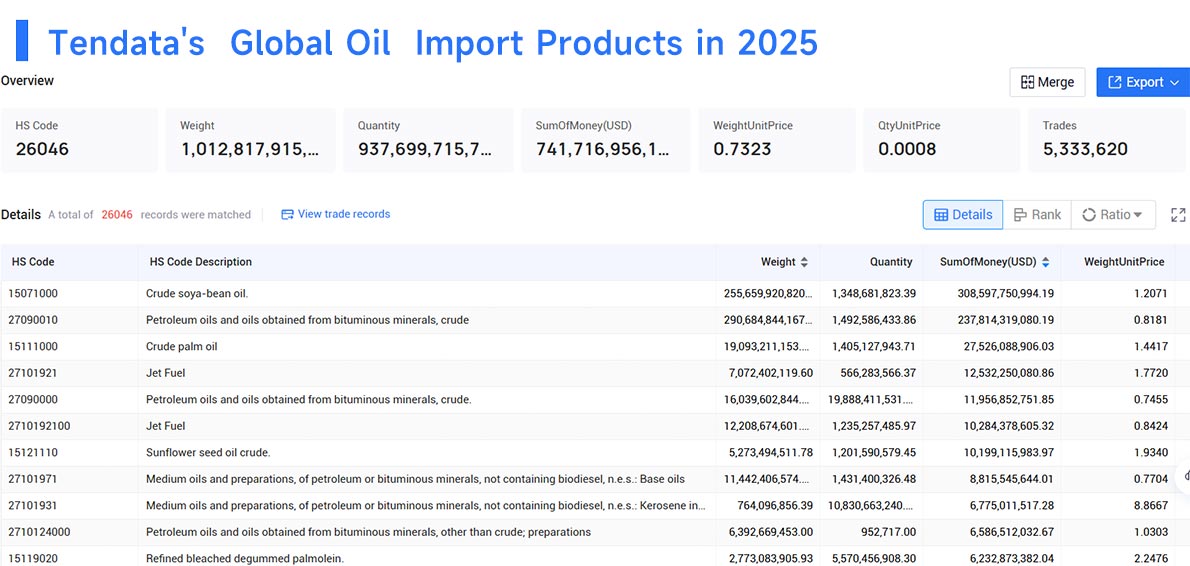
According to Tendata global trade data, oil imports in 2025 show a highly diversified structure across both energy commodities and agricultural oils, reflecting the dual demand from industrial consumption and food supply chains. The largest share is dominated by HS Code 15071000 (Crude Soya-bean Oil), accounting for 41.61% ($308.60 billion) of total imports, indicating strong global demand for edible oils driven by population growth and food processing industries.
Closely following is HS Code 27090010 (Crude Petroleum Oils) at 32.06% ($237.81 billion), highlighting the continued reliance on crude oil as a primary energy source despite ongoing energy transition efforts. Other significant categories include crude palm oil (HS 15111000) and sunflower seed oil (HS 15121110), reinforcing the importance of vegetable oils in global trade.
Refined and processed petroleum products such as jet fuel (HS 27101921) and medium oils (HS 27101971 & 27101931) also contribute notable shares, reflecting stable demand from aviation, transportation, and industrial sectors. Additionally, refined palm oil (HS 15119020) indicates value-added processing trends in the edible oil segment.
Top Oil Importing Countries
According to Tendata global trade data, below is the list of major auto part importing countries in 2025:
1.India (78.42%, $581.62 Billion)
2.Brazil (5.97%, $44.30 Billion)
3.Pakistan (3.32%, $24.61 Billion)
4.Ivory Coast (2.49%, $18.47 Billion)
5.Vietnam (2.25%, $16.69 Billion)
6.Bangladesh (1.01%, $7.47 Billion)
7.Chile (0.73%, $5.45 Billion)
8.Peru (0.72%, $5.35 Billion)
9.Colombia (0.58%, $4.30 Billion)
10.Philippines (0.52%, $3.87 Billion)
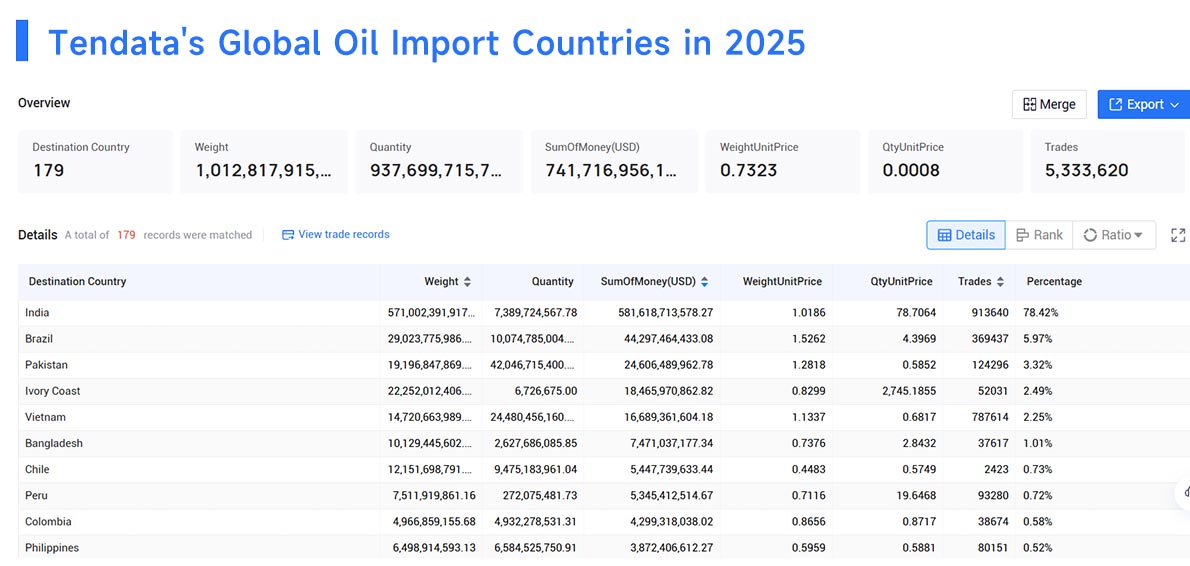
According to Tendata global trade data, the global oil import market in 2025 is highly concentrated, with a clear dominance by a few key economies. Analysis of oil imports by country shows that India leads by a significant margin, accounting for 78.42% ($581.62 billion) of total oil imports, reflecting its massive energy demand driven by industrial expansion, population growth, and limited domestic oil reserves.
Far behind India, Brazil (5.97%, $44.30 billion) and Pakistan (3.32%, $24.61 billion) rank as the second and third largest importers. Insights from oil imports by country highlight strong energy consumption in these emerging markets. Other notable importing countries include Ivory Coast (2.49%), Vietnam (2.25%), and Bangladesh (1.01%), which are experiencing rapid industrialization and increasing reliance on imported oil to support manufacturing and infrastructure development.
Smaller but still significant importers such as Chile, Peru, Colombia, and the Philippines collectively contribute to the remaining share. Overall, oil imports by country indicate a broad geographic distribution of demand across Latin America and Southeast Asia, while still maintaining a highly concentrated global market structure.
Top Global Oil Importers in 2025
According to Tendata global trade data, here is the list of top auto part importers worldwide in 2025:
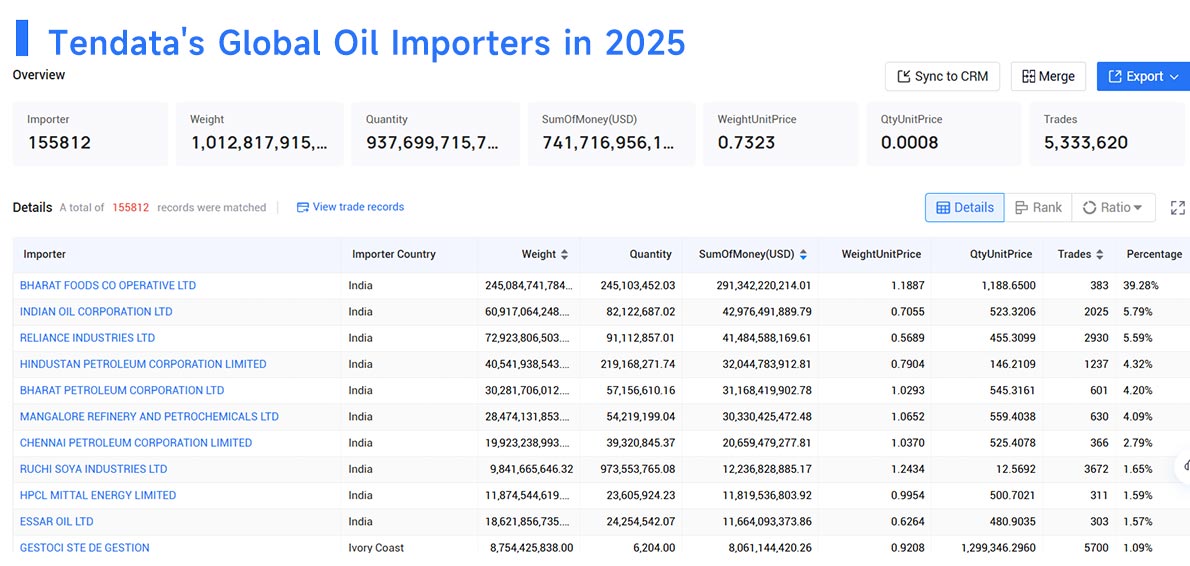
1.BHARAT FO (39.28%, $291.34 Billion)
2.INDIAN OIL (5.79%, $42.98 Billion)
3.RELIANCE I (5.59%, $41.48 Billion)
4.HINDUSTAN (4.32%, $32.04 Billion)
5.BHARAT PE (4.20%, $31.17 Billion)
6.MANGALORE (4.09%, $30.33 Billion)
7.CHENNAI PE (2.79%, $20.66 Billion)
8.RUCHI SOY (1.65%, $12.24 Billion)
9.HPCL MITTA (1.59%, $11.82 Billion)
10.ESSAR OIL (1.57%, $11.66 Billion)
How to find Oil Products Import Data?
Finding accurate oil import data requires a structured approach based on HS codes, country filters, and transaction-level records. In global trade analysis, HS codes serve as the foundation for identifying oil-related products such as crude petroleum, refined fuels, and vegetable oils. By using HS codes, businesses can precisely track import volumes, values, and trade flows across different markets.
With Tendata, users can streamline this process through an integrated data platform. First, you can search oil-related HS codes (e.g., crude oil, jet fuel, palm oil) to define the product scope. Then, filter by importing country, time period, and trade value to analyze market demand and identify high-growth regions. The platform provides detailed shipment-level data, including importer names, supplier relationships, pricing trends, and transaction frequency, enabling a granular understanding of the oil trade landscape.
In addition, Tendata enhances traditional data lookup by combining global customs data, logistics records, and business intelligence, allowing users not only to view historical oil import statistics but also to discover active buyers, monitor competitors, and evaluate market entry opportunities. This makes it possible to move beyond basic data retrieval and build a data-driven strategy for targeting high-potential oil import markets and customers.
Final Words
The global oil import market in 2025 reflects a high-value, high-demand, and strategically critical trade landscape, with total imports reaching over $741.72 billion across 179 countries and more than 155,000 importers. From crude petroleum to refined fuels and edible oils, the diversity of oil-related products highlights the essential role these commodities play in supporting energy systems, industrial production, and global food supply chains.
At the same time, the market structure reveals a clear imbalance—a small number of countries and key buyers dominate global demand, while millions of transactions indicate continuous and dynamic trade activity. This creates both opportunities and challenges for exporters, who must identify not only large-volume markets but also stable, repeat buyers with consistent purchasing cycles.
FAQ
1.What is oil import data and why is it important?
Oil import data includes detailed records of cross-border transactions such as product type (via HS codes), import value, quantity, origin country, and buyer information. This data is essential for understanding global energy demand, tracking price trends, and identifying high-potential markets. It also helps businesses evaluate supply chain dynamics and competitive positioning.
2.How can I find reliable oil import data?
To find accurate oil import data, you should start by identifying relevant HS codes (e.g., crude oil, refined petroleum, vegetable oils) and then analyze trade flows by country and time period. Professional databases aggregate customs records, shipping manifests, and statistical sources to provide structured insights into global trade activities .
3.What kind of oil import insights can Tendata provide?
Tendata offers transaction-level oil import data, including importer names, shipment values, trade frequency, supplier relationships, and pricing trends. This allows users to identify top buyers, active importers, and stable purchasing patterns, rather than relying only on aggregated statistics.
4.How does Tendata help in finding oil buyers?
With Tendata, users can filter oil import data by country, HS code, and time range to quickly locate companies that are actively importing oil products. The platform also provides contact information and company profiles, enabling direct outreach to verified buyers and improving lead generation efficiency.
5.Can Tendata support market analysis and strategy for oil exports?
Yes. Beyond raw data, Tendata integrates AI-driven analysis and trade intelligence, helping businesses uncover demand trends, monitor competitors, and identify emerging markets. This enables companies to build data-driven export strategies, optimize customer targeting, and reduce market entry risks in the global oil trade.
Category
Leave Message for Demo Request or Questions