
Top 10 US Car Imports by Country & Company - Tendata
 Import News
 2026-04-07
Keypoints
· The structure of US car imports by country shows a highly concentrated supply pattern, where a few dominant countries account for the majority of import value, while a long tail of emerging markets provides supplementary supply support.
· Major supplier countries such as Mexico, Japan, South Korea, Canada, and Germany continue to dominate US car imports by country, supported by regional trade agreements and deeply integrated manufacturing networks.
· The import structure is not limited to finished vehicles (HS Code 8703), but also heavily relies on auto parts (HS Code 8708), indicating a hybrid model of global sourcing and domestic assembly in the U.S. automotive industry.

The global automotive industry plays a critical role in supporting transportation, manufacturing, logistics, and consumer mobility across the world. From passenger vehicles to advanced electric and hybrid models, automotive trade continues to drive international commerce and industrial development. In this context, analyzing US car imports by country provides valuable insight into global supply chains, sourcing strategies, and shifting trade dynamics within one of the world’s largest automotive markets.
Understanding the structure of US car imports by country helps businesses identify leading supplier nations, evaluate production strengths, and uncover emerging opportunities in both finished vehicles and auto components. This blog explores key trends in the U.S. automotive import market based on global trade data, highlighting major supplying countries, import patterns, relevant HS codes, and evolving market dynamics shaping the future of automotive trade.
US Car Import Data: 2025 Overview
The United States remains one of the most influential automotive import markets globally, driven by strong consumer demand, diversified sourcing, and highly integrated global supply chains. According to trade data, the U.S. is the largest importer of cars worldwide, accounting for a significant share of global vehicle trade and maintaining a highly internationalized procurement structure.
Based on Tendata-style trade metrics, US car imports by country reflect a broad and active import network, with 27,876 importers sourcing vehicles from 109 destination countries, generating a total import value of $5.58 billion across 476,594 trade transactions. This highlights not only the scale but also the fragmentation of the U.S. automotive import ecosystem. The market is heavily concentrated among key supplier countries such as Mexico, Japan, South Korea, Germany, and Canada, which together account for the majority of import value, reinforcing regional supply chain integration and long-term trade dependencies.
Overall, the structure of US car imports by country demonstrates a mature, demand-driven market characterized by high transaction frequency, strong reliance on international production hubs, and continuous trade flows that support both consumer sales and dealer inventory replenishment across the United States.
List of Major US Car Importing HS Code
According to Tendata global trade data, here is the list of top US car HS Codes in 2025:
1.HS Code:39199090(10.13%, $565.73 Million):Self-adhesive tapes, plates, strips of plastic (other than cellophane), in rolls, n.e.s.
2.HS Code:85044029(4.62%, $258.08 Million):Static converters: Other rectifiers (excluding those for electrical traction)
3.HS Code:85044090(4.52%, $252.23 Million):Static converters: Others (excluding those for A.V. receivers)
4.HS Code:85044050(4.13%, $230.44 Million):Semiconductor devices including thyristors, LEDs, transistors, and related components
5.HS Code:85044010(3.88%, $216.43 Million):Electric inverters (excluding those for motor speed regulation)
6.HS Code:89052000(3.40%, $190.00 Million):Drilling or exploitation platforms, floating or submersible
7.HS Code:8703809010(2.87%, $160.44 Million):Motor cars and other vehicles for transport of persons (incl. saloon cars, coupes, vans)
8.HS Code:85044021(2.85%, $159.32 Million):Static converters: Diode bridge rectifiers
9.HS Code:87080000(2.80%, $156.48 Million):Parts and accessories of motor vehicles (headings 87.01–87.13)
10.HS Code:39191090(2.79%, $155.67 Million):Polymeric self-adhesive plates, sheets, film, foil, tape and strips (≤20 cm width)
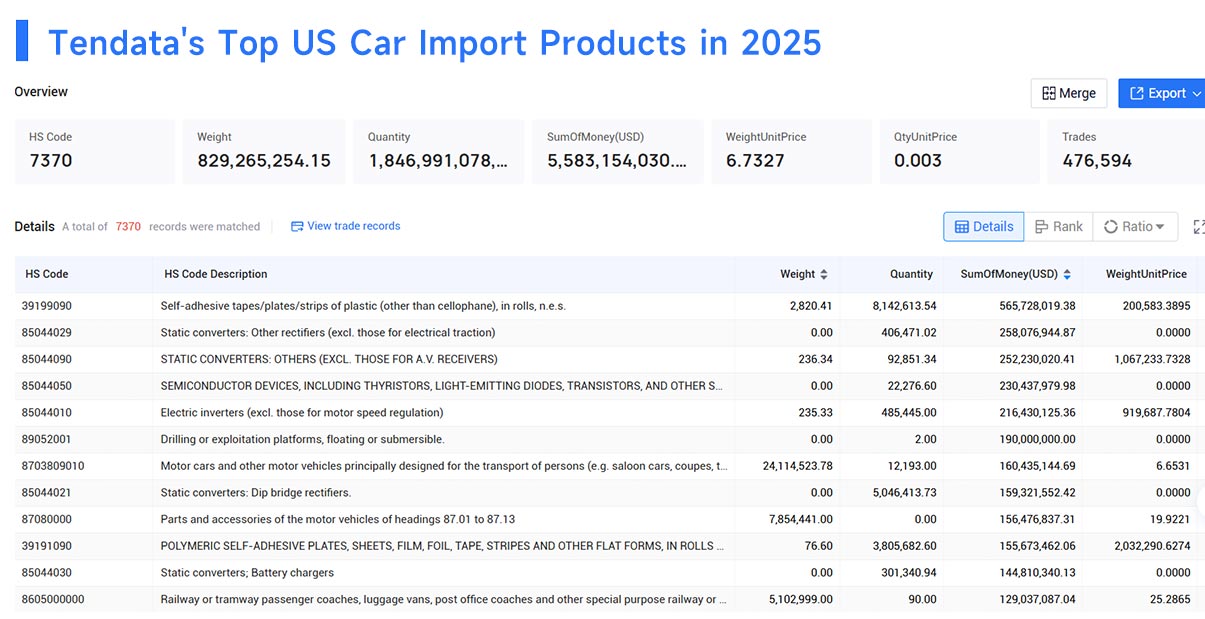
The composition of US car imports by country can be clearly understood through key automotive HS code categories and their corresponding trade value distribution. In the U.S. import system, passenger vehicles are primarily classified under HS Code 8703 (motor cars and other vehicles for transporting persons), while auto components and supply chain inputs are largely concentrated under HS Code 8708 (parts and accessories of motor vehicles) .
Based on the provided dataset, the structure of US car imports by country is not limited to finished vehicles but is deeply supported by a broad range of upstream and midstream components. For example, HS Code 8703809010 (passenger vehicles) represents a core finished vehicle segment, while HS Code 87080000 (vehicle parts and accessories) highlights the strong dependence on imported components within the U.S. automotive ecosystem. In addition, high-value electronic and semiconductor-related categories such as HS Code 850440xx (static converters, inverters, and semiconductor devices) play a critical role in modern automotive imports, especially with the rise of electric vehicles and smart automotive systems.
Top US Car Importing Countries
According to Tendata global trade data, below is the list of major US car importing countries in 2025:
1.Brazil(54.22%, $3027.40 Million)
2.Mexico(13.91%, $776.86 Million)
3.Ukraine(12.22%, $682.39 Million)
4.Colombia(6.49%, $362.54 Million)
5.India(4.48%, $250.28 Million)
6.Peru(2.58%, $143.88 Million)
7.Vietnam(1.50%, $83.53 Million)
8.Ghana(0.69%, $38.72 Million)
9.Ivory Coast(0.57%, $32.04 Million)
10.Panama(0.48%, $26.91 Million)
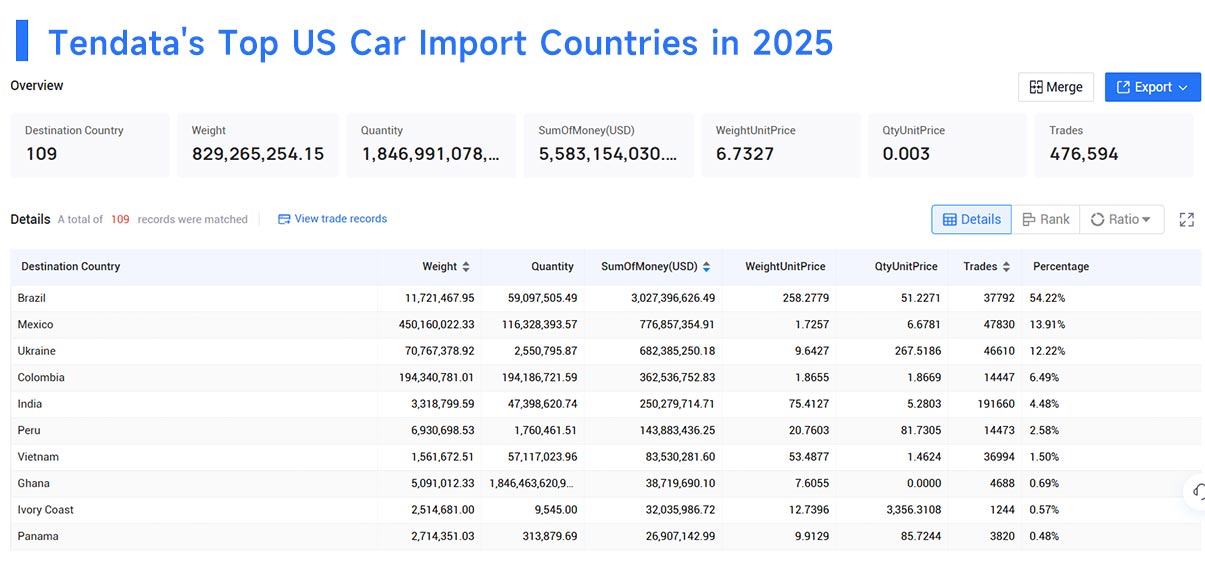
Based on the provided data, US car importing by country is led overwhelmingly by Brazil, which accounts for 54.22% ($3,027.40 Million) of total import value, indicating a strong supply dominance within this specific dataset. This is followed by Mexico (13.91%, $776.86 Million) and Ukraine (12.22%, $682.39 Million), both playing significant roles in supporting U.S. automotive demand. Mid-tier contributors such as Colombia (6.49%, $362.54 Million) and India (4.48%, $250.28 Million) further highlight the diversification of sourcing channels beyond traditional partners.
Lower-share countries including Peru, Vietnam, Ghana, Ivory Coast, and Panama collectively contribute a smaller but strategically relevant portion of imports, reflecting niche supply chains and specialized vehicle or component flows. This layered structure demonstrates that US car imports by country are not only driven by major trading partners but also supported by a long tail of emerging markets, reinforcing the complexity and resilience of the U.S. automotive import ecosystem.
Top US Car Importers in 2025
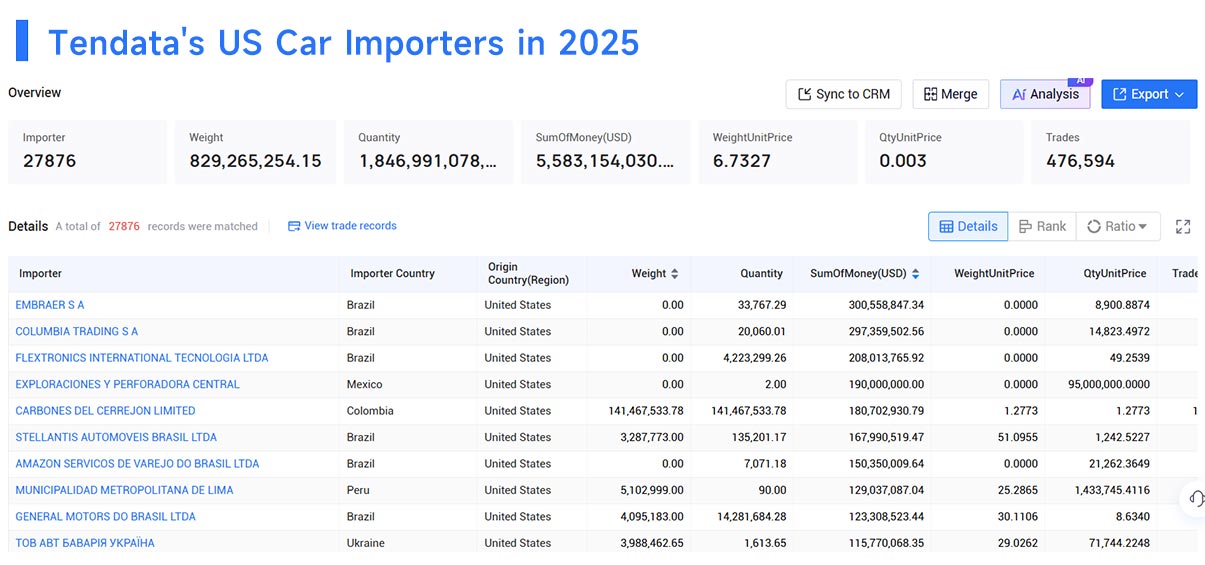
According to Tendata global trade data, here is the list of top US car importers worldwide in 2025:
1.EMBRAER S A(5.38%, $300.56 Million)
2.COLUMBIA TRADING S A(5.33%, $297.36 Million)
3.FLEXTRONICS INTERNATIONAL TECNOLOGIA LTDA(3.73%, $208.01 Million)
4.EXPLORACIONES Y PERFORADORA CENTRAL(3.40%, $190.00 Million)
5.CARBONES DEL CERREJON LIMITED(3.24%, $180.70 Million)
6.STELLANTIS AUTOMOVEIS BRASIL LTDA(3.01%, $167.99 Million)
7.AMAZON SERVICOS DE VAREJO DO BRASIL LTDA(2.69%, $150.35 Million)
8.MUNICIPALIDAD METROPOLITANA DE LIMA(2.31%, $129.04 Million)
9.GENERAL MOTORS DO BRASIL LTDA(2.21%, $123.31 Million)
10.TOB ABT БАРВИ УКАЇНА(2.07%, $115.77 Million)
How to Find US Car Import Data with Tendata?
Business usinesses can systematically analyze US car imports by country by using structured trade intelligence platforms like Tendata. The U.S. automotive import market is highly data-intensive, with monthly imports of vehicles and parts reaching tens of billions of dollars and showing consistent growth trends . This makes accurate, real-time data essential for identifying opportunities and reducing market uncertainty.
With Tendata, users can easily track US car imported by country by accessing shipment-level customs data, filtering by HS Code (such as HS 8703 for passenger vehicles), and analyzing key dimensions including importer names, supplier countries, transaction value, and trade frequency. The platform enables users to identify which countries dominate supply, how sourcing patterns shift over time, and which buyers maintain stable procurement cycles. For example, by using the “Analysis Report” module, businesses can quickly pinpoint top destination countries, evaluate import concentration, and uncover high-frequency buyers with continuous purchasing behavior.
More importantly, Tendata integrates multi-source global trade data with AI-driven insights, allowing users to move beyond static statistics and gain actionable intelligence. Companies can monitor changes in US car imports by country, detect emerging markets, and validate real buyers based on 12-month procurement activity. This data-driven approach significantly improves customer targeting, reduces invalid inquiries, and supports more precise market entry and expansion strategies in the competitive U.S. automotive sector.
Final Words
The markt is both highly concentrated and globally interconnected, offering significant opportunities for data-driven decision-making. The U.S. remains one of the largest automotive import markets in the world, with monthly imports of autos and parts exceeding $38 billion, reflecting strong and continuous demand supported by global supply chains .
From the perspective of US car importing by country, the market shows a dual structure: a concentration of value among key supplier countries and a long tail of emerging sourcing regions. This pattern underscores the importance of identifying not only dominant markets but also niche suppliers that may present untapped opportunities. For businesses, understanding these dynamics is critical to optimizing sourcing strategies, identifying stable buyers, and responding to shifts in global automotive trade flows.
This is where Tendata delivers clear strategic value. By combining multi-source customs data with AI-driven analytics, Tendata enables users to deeply analyze US car imports by country, track real buyers with continuous purchasing records, and monitor changes in supplier structures over time. Instead of relying on fragmented or delayed information, companies can use Tendata to gain real-time visibility into US car importing by country, uncover high-potential markets, and build precise customer acquisition strategies.
Ultimately, in a competitive and rapidly evolving automotive trade environment, leveraging accurate trade data is no longer optional—it is essential. Businesses that integrate platforms like Tendata into their workflow can move faster, reduce uncertainty, and turn complex import data into actionable growth opportunities in the U.S. automotive market.
FAQ
1.What does “US car imports by country” mean and why is it important?
US car imports by country refers to the breakdown of U.S. automotive imports based on supplier countries, typically analyzed using HS codes such as 8703 (passenger vehicles) and 8708 (auto parts).
This metric helps businesses understand which countries dominate supply, evaluate market concentration, and identify emerging sourcing regions. It is especially valuable for exporters and suppliers aiming to enter or expand in the U.S. automotive market.
2. How can I find detailed data on “US car imported by country”?
To analyze US car imported by country, companies can use trade intelligence platforms like Tendata. By filtering data using HS codes, users can access shipment-level records that include importer names, supplier countries, transaction values, and trade frequency.
This allows businesses to move beyond general statistics and identify real buyers, track procurement cycles, and monitor changes in sourcing patterns over time.
3.How does analyzing “US car importing by country” help business growth?
Understanding US car importing by country helps companies pinpoint high-potential markets, reduce invalid leads, and build precise customer acquisition strategies. By focusing on buyers with continuous purchasing records and stable supply chains, businesses can improve conversion rates and shorten sales cycles.
4. Why is Tendata better than traditional trade data sources?
Traditional sources often provide fragmented or delayed data. Tendata, however, aggregates multi-source global trade data and applies AI-driven analysis, enabling real-time insights into US car imported by country. This helps businesses quickly adapt to market changes, validate demand, and make data-backed decisions in a highly competitive automotive trade environment.
Category
Leave Message for Demo Request or Questions