
Lithium Battery Importing From the USA: The Customs Data Advantage – Tendata
 Import News
 2026-05-25
Key Points
· The market for lithium battery importing from the usa continues to expand rapidly due to EVs, energy storage systems, and consumer electronics demand.
· The United States has become one of the world’s most important lithium battery export hubs.
· Customs data provides direct visibility into real buyers, suppliers, pricing, and shipment frequency.
· Professional trade shows, B2B platforms, LinkedIn, and industry associations remain important development channels.
· Tendata helps exporters identify genuine buyers and analyze global lithium battery trade trends using real customs records.

Overview
The market for lithium battery importing from the usa is entering a new stage of rapid expansion. As the global transition toward renewable energy accelerates, lithium batteries have become one of the most important products in international trade. The United States now plays a critical role in the global lithium battery supply chain, supported by strong demand from electric vehicles, energy storage projects, and consumer electronics manufacturers.
According to data from the U.S. Census Bureau, U.S. lithium-ion battery exports reached a historical peak of approximately USD 578.7 million in September 2024. Export performance throughout 2025 also remained strong, showing sustained international demand for American battery products and technologies. Compared with 2012, when monthly export values were still below USD 2 million, the growth of lithium battery importing from the usa has been remarkable.
Major export products include lithium-ion batteries (HS Code 850760), lithium primary batteries (HS Code 850650), battery management systems, and related battery components. North America, Europe, and Asia remain the primary destination markets, especially in electric vehicle and energy storage applications. At the same time, U.S. domestic battery manufacturing capacity continues to expand rapidly under clean energy policies and industrial investment programs.
Best Channels to Develop the Lithium Battery Importing From the USA Market
1. U.S. Professional Trade Shows
Attending professional exhibitions remains one of the most effective ways to connect with global buyers involved in lithium battery importing from the usa.
(1) The Battery Show North America 2026
Time: October 13–15, 2026
Location: Detroit, Michigan, USA
This is the largest battery and electric vehicle technology exhibition in North America. The event gathers more than 500 leading global companies covering lithium-ion batteries, solid-state batteries, sodium-ion batteries, battery testing equipment, energy storage systems, and EV technologies.
Website: www.thebatteryshow.com
(2) The Battery Show South 2026
Time: April 22–23, 2026
Location: Charlotte, North Carolina, USA
Focused on the rapidly growing battery manufacturing ecosystem in the southeastern United States, this exhibition covers advanced battery technologies, EV systems, energy storage, and smart manufacturing.
Website: www.thebatteryshowsouth.com
(3) RE+ 2026
Time: November 17–19, 2026
Location: Las Vegas, Nevada, USA
RE+ is one of the world’s largest renewable energy exhibitions, covering photovoltaic systems, lithium battery storage solutions, BMS systems, grid-scale storage, and EV charging infrastructure.
Website: www.re-plus.com
(4) BCI Convention + Power Mart Expo 2026
Time: May 3–6, 2026
Location: Nashville, Tennessee, USA
Hosted by Battery Council International (BCI), this event is one of the oldest and most influential battery industry conferences globally, bringing together manufacturers, suppliers, recyclers, and battery technology innovators.
Website: convention.batterycouncil.org
Search Engines and Business Directories
Google remains the dominant search engine in the United States, and many importers involved in lithium battery importing from the usa can be identified through keyword searches such as “lithium battery importer USA,” “battery distributor North America,” “energy storage system buyer,” and “EV battery procurement.”
In addition to search engines, business directories such as ThomasNet and Manta are highly useful for identifying industrial buyers and battery distributors. ThomasNet covers hundreds of thousands of North American industrial companies and is widely used by procurement professionals. Manta focuses more on small and medium-sized enterprises and can help exporters discover niche buyers and regional distributors.
ThomasNet: www.thomasnet.com
Manta: www.manta.com
Social Media and Professional Networks
LinkedIn has become one of the most effective channels for developing the lithium battery importing from the usa market. Procurement managers, purchasing directors, and battery industry executives actively use LinkedIn to build business relationships and monitor industry developments. Exporters can also follow organizations such as NAATBatt International to stay updated on battery technology trends and policy changes.
X is another useful platform for tracking developments in electric vehicles, energy storage systems, and renewable energy projects across North America.
B2B Platforms and Vertical Platforms
B2B platforms remain important for global sourcing activities related to lithium battery importing from the usa. ThomasNet functions not only as an industrial directory but also as a sourcing platform for battery-related products. Alibaba International is still widely used by U.S. buyers searching for overseas suppliers and comparing product pricing. In the energy storage sector, vertical platforms such as EnergySage have become increasingly important channels for battery system procurement and renewable energy project sourcing.
Industry Associations and Government Resources
Industry associations and government institutions provide valuable information for companies entering the lithium battery importing from the usa market. NAATBatt International is one of the core advanced battery industry alliances in North America and offers industry reports, member directories, and networking opportunities. The U.S. Department of Energy regularly publishes battery technology research, storage policy updates, and market analysis reports. Meanwhile, the U.S. Census Bureau and the U.S. International Trade Commission provide important macro-level trade statistics and tariff information.
U.S. Customs Data — The Core Competitive Advantage
Although exhibitions, B2B platforms, and search engines can help exporters identify potential companies, they cannot answer the most important business questions: Which companies are actually importing lithium batteries from the United States? How much are they purchasing? Which suppliers are they buying from? What prices are they paying? These are exactly the questions that customs data can answer.
For companies involved in lithium battery importing from the usa, customs data has become the most powerful market development tool, and this is where Tendata provides significant advantages.
The Customs Data Advantage: Why Tendata Matters
Advantage 1: Identify Real Buyers Directly
Traditional development channels may only reveal companies that potentially operate in the battery industry, but they cannot confirm whether these companies are actively importing lithium battery products. Tendata customs data directly displays real shipment records, including importer names, exporter names, product descriptions, quantities, prices, shipment frequency, and logistics details.
For example, by searching HS Code 850760, users can directly identify companies actively involved in lithium battery importing from the usa. Real buyers identified through customs records include VIVAN USA INC, APEXHORIZON DYNAMICS INC, ADI GLOBAL, and OKI LLC. This allows exporters to target verified buyers instead of relying on guesswork.
Advantage 2: Analyze Competitors and Market Structure
The global battery market is evolving rapidly. Chinese manufacturers such as CATL and BYD continue expanding globally, while the United States is simultaneously strengthening domestic battery manufacturing capacity. Through Tendata’s competitive analysis tools, exporters can monitor which buyers competitors are supplying, which U.S. exporters are growing fastest, and which international markets are showing rising demand for lithium batteries.
This level of analysis helps companies develop more strategic approaches to lithium battery importing from the usa, especially when evaluating pricing structures, product positioning, and emerging opportunities.
Advantage 3: Understand Procurement Patterns
The U.S. market places strong emphasis on supply chain stability, product consistency, and pricing transparency. Blind quotations often fail because suppliers do not fully understand buyer purchasing behavior. Tendata allows users to analyze procurement frequency, shipment volume, trading partners, average transaction prices, and supply chain structures. Based on this information, exporters can identify high-value buyers, optimize quotation strategies, and determine the best timing for market entry.
Advantage 4: Discover Emerging Markets
Global lithium battery trade flows are changing rapidly. In addition to mature markets such as North America and Europe, emerging markets including Vietnam, Chile, Australia, and Saudi Arabia are experiencing strong import growth. Through Tendata, exporters can identify which countries are showing the fastest growth in lithium battery importing from the usa, monitor new market entrants, and evaluate the impact of trade policy changes before competitors react.
Advantage 5: Multi-Country Data Coverage
Tendata provides global trade intelligence covering 228 countries and regions, including business data from 198 countries and internet data from 172 countries. Supported by more than 10 billion trade records and over 500 million enterprise profiles, the platform allows exporters to compare pricing trends, supplier structures, and buyer demand across multiple markets. This helps companies build more comprehensive global strategies instead of focusing on only one country or region.
What Tendata Delivers
Tendata provides complete U.S. customs import and export records related to lithium battery importing from the usa, including exporter names, importer names, product descriptions, HS codes, shipment quantities, net weight, transportation methods, shipment dates, and unit pricing information. Unlike free customs statistics that only show aggregated numbers, Tendata reveals the actual trading relationships behind every shipment.
The platform also supports precise HS code searches. For lithium battery products, commonly used HS codes include HS 850760 for lithium-ion batteries, HS 850650 for lithium primary batteries, HS 850440 for chargers and power converters, and HS 903033 for battery testing instruments. Among these, HS 850760 is the primary starting point for researching lithium battery importing from the usa.
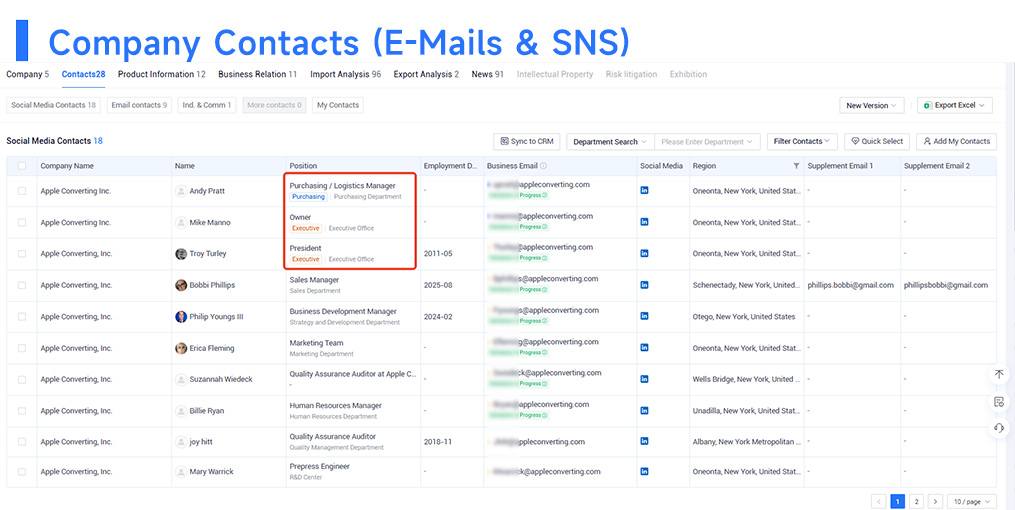
Another important advantage is Tendata’s decision-maker contact database. By integrating customs records with business databases and internet data, the platform provides access to procurement managers, CEOs, and sales directors, including corporate email addresses and LinkedIn profiles. Combined with AI-powered buyer recommendation technology, Tendata can automatically recommend potential customers based on keywords such as “lithium battery,” “Li-ion battery,” and “energy storage.”
How to Use the Customs Data Advantage
The first step is to identify the correct product keywords and HS codes. Exporters can search terms such as “lithium battery,” “Li-ion battery,” or directly use HS Code 850760 to access related trade records.
The second step is to filter U.S. export records by selecting “United States” as the exporter country. This allows users to identify active buyers involved in lithium battery importing from the usa and sort them by shipment value, transaction frequency, or recent activity.
>>> Get More Lithium Battery Importing From the USA via Tendata <<<
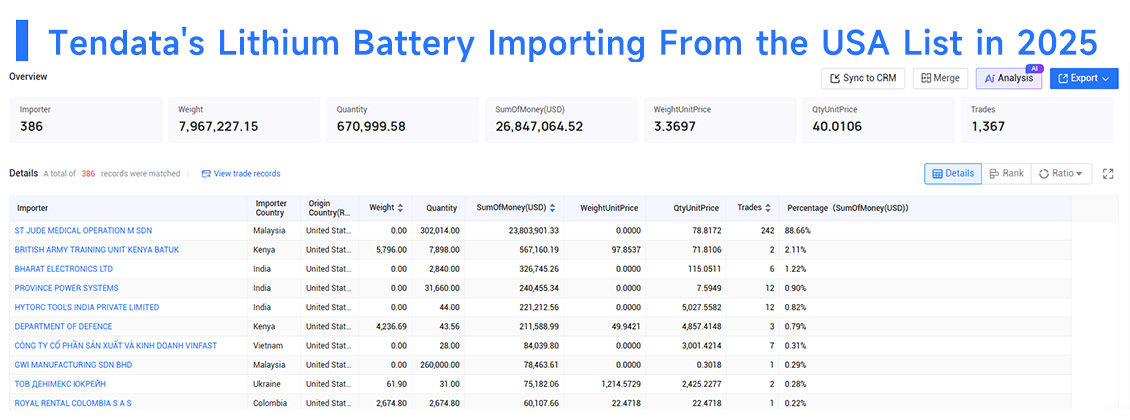
The third step is to analyze buyer transaction records, including product categories, shipment frequency, pricing levels, and supply chain relationships. This helps determine whether a buyer is suitable for long-term cooperation.
The final step is to obtain buyer contact information and conduct targeted outreach. Since many U.S. buyers prefer formal business communication, exporters typically begin with email introductions and later continue follow-up discussions through phone calls or LinkedIn.
>>> Obtaining Customer Contact Information from Tendata <<<
Summary
The market for lithium battery importing from the usa is entering a historic growth period. Driven by electric vehicles, renewable energy storage systems, and global battery demand, the United States has become one of the most important hubs in the international lithium battery supply chain.
However, success in lithium battery importing from the usa requires more than competitive products alone. Companies must understand who the real buyers are, which suppliers they purchase from, how frequently they buy, and what pricing structures they accept. These answers are hidden inside customs data.
Tendata provides real U.S. customs import and export records, complete buyer and supplier information, decision-maker contacts, AI-powered buyer recommendations, and global trade intelligence tools that help exporters identify opportunities faster and develop international markets more efficiently.
For companies aiming to expand in the global lithium battery industry, data-driven market development is no longer optional — it has become the core competitive advantage.
Category
Leave Message for Demo Request or Questions