
Unlocking the Japanese Cable Market: Why Customs Data is Your Competitive Edge for Cables Japanese Imports - Tendata
 Import News
 2026-05-25
Key Points
· Japan remains one of the world’s largest and most technology-driven cable import markets.
· Renewable energy, smart grids, AI infrastructure, and data centers are accelerating demand for advanced cable products.
· Power cables currently dominate the Japanese cable market with approximately 67% market share.
· Submarine cables, fiber optic cables, and eco-friendly cables are becoming high-growth segments.
· Traditional buyer development methods cannot accurately identify real importers.
· Tendata customs data helps suppliers directly identify active buyers in the cables japanese imports market.
Overview
Japan is the world’s third-largest economy and one of Asia’s most important import markets for wire and cable products. As the Japanese government accelerates green transformation policies, smart grid deployment, renewable energy integration, semiconductor expansion, and AI-driven data center construction, demand for cables and related electrical infrastructure continues to grow steadily.
For companies aiming to enter the cables japanese imports market, understanding market demand alone is no longer enough. Exporters also need accurate buyer intelligence, real procurement records, and competitive market analysis. This is exactly where customs data becomes a decisive advantage.
Based on the Tendata database, this guide explains the latest trends, buyer development channels, and customs-data-driven strategies for developing the cables japanese imports market efficiently.
Cables Japanese Imports Market Overview
The cables japanese imports market is currently supported by three major growth drivers: infrastructure modernization, renewable energy expansion, and digital connectivity demand.
Japan’s wire and cable market reached approximately USD 17.66 billion in 2025, while some industry statistics estimate the market at around USD 12.61 billion depending on calculation methods and product scope. Industry forecasts indicate that the market will continue expanding steadily through 2034, driven by smart infrastructure investments and clean energy projects.
Among all product categories, power cables remain the dominant segment, accounting for nearly 67% of total market share. The power sector itself contributes approximately 41% of end-user demand, mainly due to nationwide grid modernization projects and Japan’s long-term decarbonization strategy.
Another major growth engine for cables japanese imports is submarine cable infrastructure. Japan is rapidly strengthening its role as a communication hub connecting Asia and North America. Massive investments in submarine fiber optic cable systems are being driven by cloud computing, AI applications, and cross-border data transmission demand.
At the same time, Japan’s smart grid transformation is accelerating. Utility companies are integrating advanced monitoring systems, predictive maintenance technologies, and renewable energy transmission solutions. This transition is significantly increasing demand for high-performance transmission and industrial cables.
Environmental regulations are also reshaping the cables japanese imports market. Demand for halogen-free flame-retardant cables and environmentally friendly cable materials continues to rise as sustainability becomes a key procurement standard in Japan.
The Japanese market remains highly competitive. Major domestic manufacturers such as Sumitomo Electric Industries, Furukawa Electric, Hitachi Metals, and Fujikura continue to dominate many segments. However, these companies are also active importers of specialized cables, advanced materials, and supplementary products.
Best Channels to Develop the cables japanese imports Market
Japanese Trade Shows
Professional exhibitions remain one of the most effective ways to connect with buyers in the cables japanese imports industry.
(1) JECA FAIR 2026
Time: May 27–29, 2026
Location: Tokyo Big Sight, Tokyo, Japan
JECA FAIR is one of Japan’s most influential electrical and power industry exhibitions. The exhibition covers transmission equipment, wire and cable products, smart grid technologies, energy storage systems, and electrical infrastructure solutions. The event attracts major Japanese engineering contractors, utility companies, distributors, and procurement managers.
Website: www.jecafair.jp
(2) JPCA Show 2026
Time: June 10–12, 2026
Location: Tokyo Big Sight, Tokyo, Japan
JPCA Show is one of Japan’s leading electronics and electronic component exhibitions. The exhibition includes wire and cable products, connectors, semiconductors, PCB technologies, and industrial electronic systems. It is an important sourcing platform for buyers involved in high-end industrial and electronic cable procurement.
Website: www.jpcashow.com
(3) Manufacturing World Tokyo 2026
Time: July 1–3, 2026
Location: Tokyo Big Sight, Tokyo, Japan
Manufacturing World Tokyo is one of Japan’s largest manufacturing exhibitions, covering industrial automation, factory equipment, robotics, industrial materials, and electronic manufacturing technologies. Many suppliers of industrial cables, automation cables, robotic harnesses, and industrial connection systems participate annually.
Website: www.manufacturing-world.jp
(4) SMART FACTORY Expo 2026
Time: September 9–11, 2026
Location: Makuhari Messe, Chiba, Japan
This exhibition focuses on smart manufacturing, IoT, industrial automation, robotics, and factory energy management systems. It is highly suitable for companies targeting industrial-grade cable buyers.
Website: www.fiweek.jp
(5) Wire Expo Japan
Time: 2026 (official dates pending)
Location: Japan
Wire Expo Japan focuses specifically on cable manufacturing technologies and equipment, covering optical fiber, power cables, and specialty cable production technologies.
Japanese Search Engines and Business Directories
Google Japan remains the dominant search engine in the country, and many Japanese importers can be identified through localized keyword searches. Exporters developing the cables japanese imports market often use Japanese search terms such as “電線ケーブル 輸入,” “電気ケーブル 仕入先,” and “ケーブル メーカー” to identify distributors, wholesalers, and procurement companies.
Website: www.google.co.jp
Important Japanese business directories include Yahoo! Japan Business Directory and PagesJaunes Japan. These platforms help exporters locate company profiles, business registrations, and contact details for companies involved in electrical materials and industrial sourcing.
Websites: biz.yahoo.co.jp
Social Media and B2B Platforms
LinkedIn usage among Japanese professionals has increased steadily in recent years, especially among procurement managers, engineers, and international sourcing departments. Meanwhile, local business networking platform Wantedly has become increasingly popular among Japanese technology companies and startups. Twitter/X is also widely used for following cable industry trends and industry associations.
For B2B sourcing, platforms such as Alibaba Japan, EC Network, and J-GoodTech remain important channels in the cables japanese imports market. J-GoodTech, supported by the Japanese government, is particularly valuable because it connects overseas suppliers with Japanese SMEs actively seeking international partnerships.
Industry Associations and Government Organizations
Industry associations and government institutions also play an important role in understanding the cables japanese imports market. The Japan Wire & Cable Manufacturers Association (JCMA) provides industry reports and member company information, while the Japan Electrical Manufacturers’ Association (JEMA) covers broader electrical equipment sectors. Japan’s Ministry of Economy, Trade and Industry (METI) regularly publishes industrial policy updates and import regulations. Meanwhile, Japan Customs offers tariff information and trade statistics that help exporters understand market demand trends.
Why Customs Data Is the Competitive Edge for cables japanese imports
Traditional buyer development methods such as exhibitions, B2B platforms, and online directories can help exporters identify potential companies, but they cannot answer the most important questions: which Japanese companies are actually importing cables, how much they are importing, where they are sourcing products from, and what prices they are paying. This is exactly why customs data has become the core competitive advantage in the cables japanese imports market.
Tendata, founded in 2005, is one of the world’s leading trade intelligence providers and one of the earliest companies deeply focused on Japanese customs data analysis. All data comes from customs authorities or verified commercial partners, ensuring strong reliability and accuracy.
Using Tendata, exporters can directly identify active Japanese importers through HS code searches such as HS 8544 for insulated wires and cables. The system provides detailed importer names, addresses, phone numbers, email addresses, websites, supplier information, shipment records, ports of loading and discharge, quantities, weights, HS codes, and product descriptions. Unlike traditional marketing methods that only reveal “possible buyers,” Tendata allows exporters to identify companies that are already actively participating in cables japanese imports transactions.
Another major advantage of Tendata is competitive analysis. Japan’s cable market is highly competitive and dominated by large domestic manufacturers, but many of these companies are also active importers of specialty cables and advanced materials. Through Tendata, exporters can analyze which Japanese companies import the largest volumes, which countries dominate supply chains, how procurement prices vary between buyers, and which product segments are growing fastest.
The platform also helps exporters improve quotation accuracy. Japan has strict quality and compliance standards, including PSE certification requirements. Blind quotations often fail because suppliers do not fully understand customer purchasing behavior. Tendata enables exporters to analyze procurement cycles, transaction prices, supplier relationships, and seasonal purchasing patterns before contacting buyers, making negotiations much more targeted and effective.
In addition, Tendata helps exporters identify fast-growing segments within the cables japanese imports market. Demand for eco-friendly cables, submarine fiber optic systems, smart grid transmission cables, semiconductor facility cables, and data center infrastructure cables is expanding rapidly. By monitoring customs records, exporters can discover which Japanese buyers are increasing imports in these segments and position themselves earlier than competitors.
Tendata provides global trade intelligence covering 228 countries and regions, including business data from 198 countries and internet data from 172 countries. Specifically for the wire and cable industry, users can access import and export data from major markets such as Japan, the United States, Germany, Vietnam, and India. The platform also integrates commercial databases and internet resources to help users identify purchasing managers, procurement directors, and CEOs directly. Backed by more than 10 billion trade records and 850 million contact profiles, Tendata significantly improves customer development efficiency for companies targeting the cables japanese imports market.
What Tendata Delivers for cables japanese imports
Tendata provides complete Japanese customs import and export records with full buyer-and-supplier-level visibility. Unlike free customs statistics that only show total import volume, Tendata reveals who imported, from whom they purchased, what products they imported, and how frequently they purchased them.
The platform supports precise HS code searches for cable-related products, including HS 8544 for insulated wires and cables, HS 8544.11 for copper winding wire, HS 8544.20 for coaxial cables, HS 8544.49 for low-voltage conductors, and HS 8544.70 for optical fiber cables.
In addition to customs data, Tendata also integrates AI-powered buyer recommendation tools. Users can quickly obtain purchasing manager names, business emails, phone numbers, LinkedIn profiles, and company decision-maker information. Based on product keywords and HS codes, the system can automatically recommend high-potential Japanese buyers that match the supplier’s target products.
The platform also provides multi-dimensional market analysis tools, allowing exporters to analyze importer distribution, procurement structures, competitor activities, and regional demand trends across Japan. This helps suppliers build more competitive pricing strategies and monitor customer procurement activity continuously.
How to Use Tendata to Develop the cables japanese imports Market
The first step is identifying the correct product keywords and HS codes. Exporters can search keywords such as cable, wire, electric cable, power cable, and fiber optic cable, while HS 8544 remains the core code for analyzing cables japanese imports data.
The second step is filtering Japanese import records. By selecting “Japan” as the importer country, the system automatically displays all relevant import records for wire and cable products. Users can sort results by import value, transaction frequency, or recent shipment activity to identify high-value buyers.
>>> Get More Cables Japanese Imports via Tendata <<<
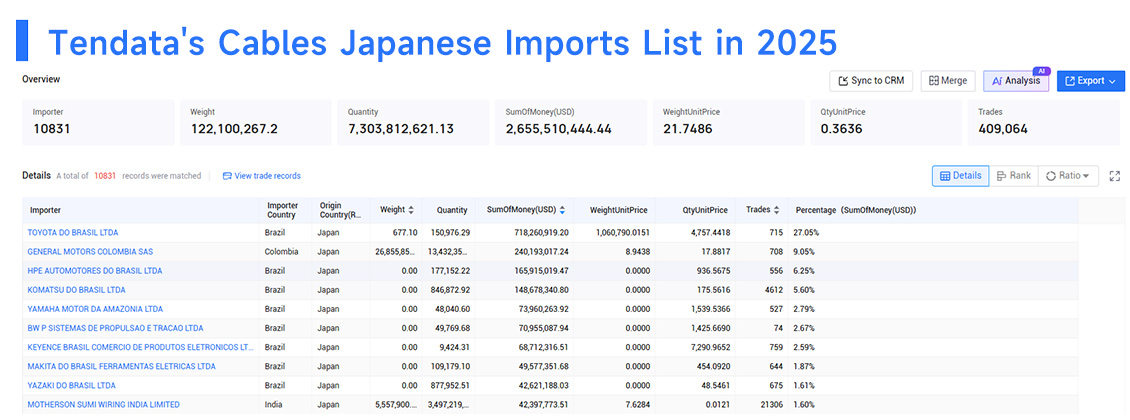
The third step is analyzing target customers. Exporters can click on any Japanese importer to review detailed transaction histories, including product categories, supplier countries, unit prices, procurement frequency, and supplier relationships. This helps determine whether the company is a distributor, manufacturer, contractor, or end user.
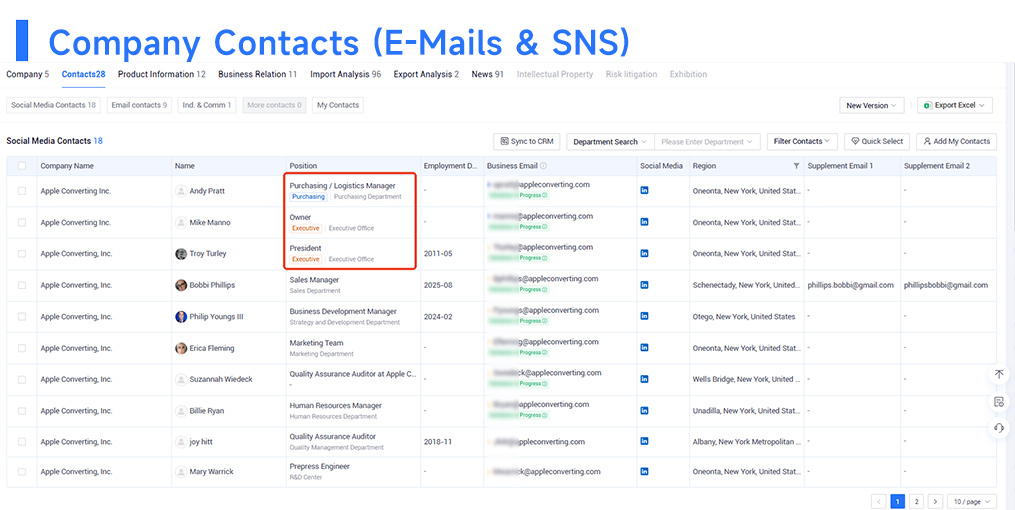
The final step is contacting decision-makers directly. Tendata provides purchasing manager emails, phone numbers, LinkedIn profiles, and company information. For the Japanese market, localized Japanese-language emails usually achieve significantly higher response rates than English emails, especially when combined with customized quotations and procurement analysis.
>>> Obtaining Customer Contact Information from Tendata <<<
Summary
The cables japanese imports market is entering a major growth cycle driven by renewable energy expansion, smart grid upgrades, AI infrastructure, submarine communication systems, and data center investments. Demand for high-performance power cables, fiber optic cables, eco-friendly cables, and industrial automation cables is expected to remain strong for many years.
However, success in the cables japanese imports market requires far more than competitive pricing or product quality. Exporters need accurate buyer intelligence, procurement visibility, supplier analysis, pricing insights, and market trend monitoring. This is exactly where customs data creates a true competitive advantage.
Tendata provides real Japanese customs import and export data, complete buyer-and-supplier information, AI-powered customer recommendations, and global trade intelligence solutions specifically designed for international trade development. For companies seeking long-term growth opportunities in the cables japanese imports market, customs data is no longer optional — it has become the core strategy for identifying real buyers and building sustainable business growth.
Category
Leave Message for Demo Request or Questions