
Is Import Export Data Public & The True Value of These Data?
 Trade Data Provider
 2025-12-02
When I first started in this industry, I also assumed that since import and export data are recorded by customs, there must be a public website where I could check everything with a single click. It wasn't until later that I realized it's not that simple. Theoretically, the import and export statistics of many countries are public information; however, from a practical application standpoint, the commercially valuable "finished data" that you can directly use is definitely not free.

The Flip Side of "Public" is "Scattered" and "Raw"
It's true that you can find some original sources. For example, the UN has the UN Comtrade database, and various national customs offices or statistics bureaus also release macro trade reports. But this data has several characteristics that give importers and exporters headaches:
· Significant Lag: If you want to find customers in the third quarter of this year, you might only be able to check aggregated data for all of last year. The business opportunity is long gone.
· Highly Aggregated: You might find that the US imported $1 billion worth of "furniture" from Vietnam last year. But which specific US companies were importing? Which factories in Vietnam did they source from? These key details are completely missing. It's like only knowing how many tons of rice a city consumed but not knowing which restaurants bought it—you still can't do business.
· Format Chaos: Data formats, languages, and statistical standards vary wildly across different countries. One company's name might be recorded as "ABC Inc." in US records but as "ABC DE MEXICO S.A. DE C.V." in Mexican data. Just unifying this information is a massive undertaking.
I once spent a week pouring over this free import and export data, trying to piece together a profile of a potential customer. The result was eye strain, messy spreadsheets, and vague conclusions. That frustration made me realize: the cost of acquiring public data is not just monetary; it's an incalculable cost in terms of time and lost opportunity.
The Value of Professional Import/Export Data Providers: Turning "Raw Material" into a "Ready-to-Eat Meal"
It wasn't until my company introduced tools like Tendata that I had an epiphany: we don't need the data itself; we need the directly usable insights behind the data. The gap between the two is where the value of a professional import/export data provider lies.
Tendata mentions they are the first in the industry to perform data governance on import and export data, and I've experienced this deeply. The most basic and crucial step is the cleansing and merging of company names. The Tendata Import Export Data Provider intelligently merges various name variants, abbreviations, and even spelling errors for the same company found across global customs records into one clear, accurate enterprise profile. This is like having a pile of messy ingredients washed, chopped, and prepped for you—you just need to throw them in the pan. Without this process, all subsequent analysis is built on shaky ground.
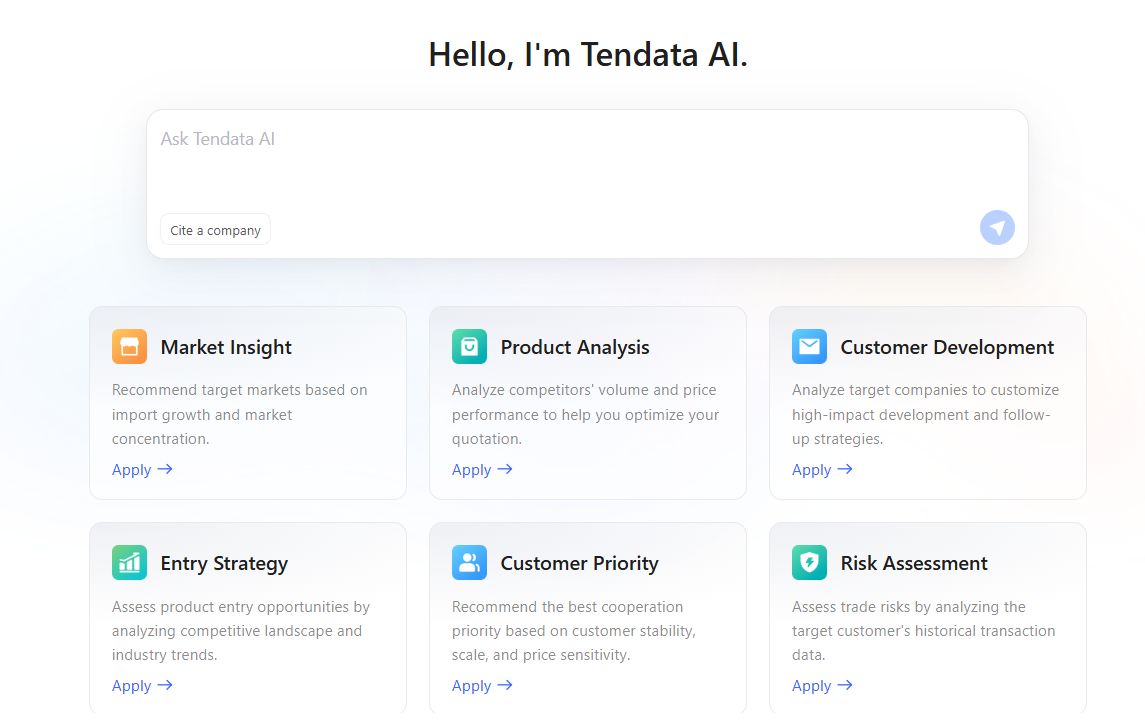
What truly made me feel the investment was worthwhile is their AI data interpretation feature. It turns cold numbers into commercially meaningful, plain language, mainly in two areas:
· Company Interpretation: When you query a potential customer, it generates not just a data report but a suggested analysis. For example, it might prompt you: "This customer's purchasing volume has been stable for the last six months, but their supplier base has increased from 2 to 4, suggesting potential dissatisfaction with existing partners and that they are testing new suppliers." This judgment provides a precise entry point and dialogue inspiration for writing your cold emails.
· Market Analysis Interpretation: When you want to enter a new market or promote a new product, you input the HS code, and it helps you analyze global trends, pointing out: "The Eastern European market shows rapid import growth but fierce price competition; the Western European market is stable in volume and high in price but has strict certification requirements." This is far more practical than just looking at a total volume number and directly guides your market strategy.
>>Learn More about Tendata AI's Capabilities<<
Specific Scenarios Where I Benefited
· Competitor Analysis: By using the enterprise comparison feature to look at a few competitors, we could clearly see that Company A focuses on high-end European and American markets, while Company B's shipments in Southeast Asia have surged in recent months. This helped us adjust our competitive strategy immediately.
· Avoiding Pitfalls: We once planned to develop a North American client whose data showed large procurement volumes. However, deeper analysis using the Company Interpretation feature revealed the client frequently changed suppliers over the past two years, with very short cooperation cycles each time. We suspected potential issues with their payment or cooperation habits and decisively lowered the priority of investment, a judgment later confirmed by peers.
So, returning to the original question: Is import and export data public? The answer is that raw, macro-level data is public, but the timely, granular, cleaned, and intelligently analyzed data service you want to obtain requires payment.
For import and export business, time is opportunity. Is your valuable time better spent cleaning and organizing raw data, or using professional tools to quickly gain insights and go straight for target customers? The answer to this choice is quite clear. We are never buying just data; we are buying efficiency and the basis for better decision-making.
Category
Leave Message for Demo Request or Questions