
Are You Really Using Trade Data Correctly? Redefining the Value of Trade Data from Three Dimensions - Tendata
 Trade Data Provider
 2026-05-27
Key Points
· Trade data helps businesses identify real market demand and avoid blind market expansion.
· Professional trade data platforms reveal competitor pricing, shipment trends, and supply chain changes.
· High-quality trade data improves buyer screening and direct access to decision-makers.
· Tendata integrates global trade intelligence, company profiles, and contact databases into one platform.
· Efficient use of trade data transforms raw information into actionable business growth.

Overview
In global business, trade data has become one of the most important foundations for decision-making. From market selection and customer development to competitor analysis and supply chain optimization, almost every stage of international trade relies on accurate trade data.
However, many companies still fail to unlock the real value behind their trade data. Some businesses rely on free public databases with outdated and incomplete information, leading to poor decisions and wasted development efforts. Others invest in paid trade data platforms but only use them to search for buyers or send emails, without leveraging the deeper strategic value hidden inside the data.
So, what kind of trade data truly supports business growth? How can companies use trade data more effectively to guide overseas expansion?
Today, we will redefine the value of trade data from three key dimensions.
The First Value of Trade Data: Understanding the Market and Finding the Right Direction
Many exporters choose markets based on instinct. When Southeast Asia becomes popular, everyone rushes into Southeast Asia. When people talk about opportunities in Africa, businesses immediately shift their focus there. This type of decision-making without reliable trade data is extremely risky.
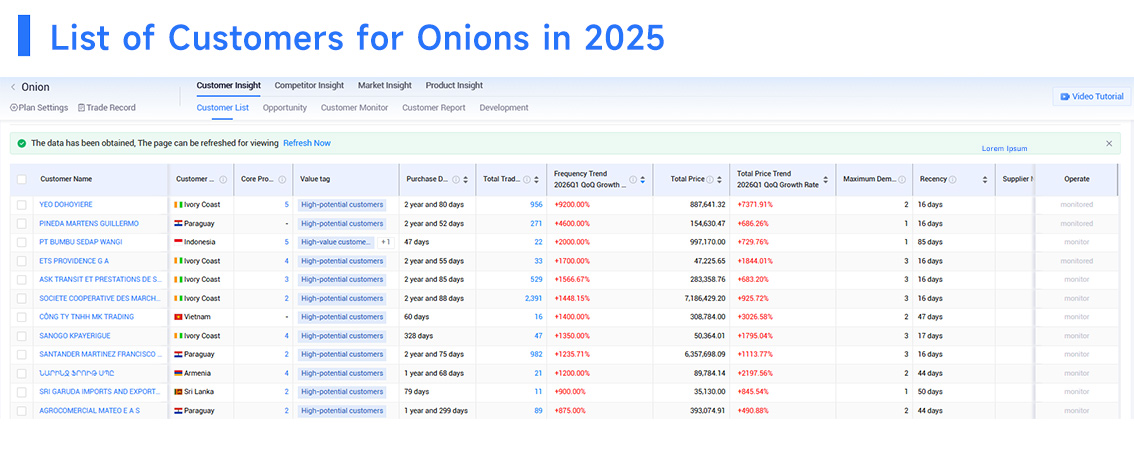
Real trade data helps companies understand the actual market situation. Using Tendata as an example, after entering a product HS code into the system, users can analyze global demand trends through massive trade data records. Businesses can clearly identify which countries are increasing imports, which markets are declining, how seasonal purchasing cycles change, and which countries dominate the competitive landscape.
More importantly, by analyzing trade flows inside the trade data, companies can identify the most promising target markets, understand how policy changes may affect business, and even evaluate more cost-effective shipping routes. Instead of relying on assumptions, companies can make decisions based on real transaction records and measurable market trends.
When trade data is used correctly, businesses no longer “guess” where opportunities are. They understand where demand is growing and where the market is moving.
Example: Using HS code 070310 (onions) to explore trade dynamics.
>>> Click to Explore Customer List <<<
The Second Value of Trade Data: Understanding Competitors and Finding Market Opportunities
Understanding competitors is just as important as understanding buyers. Yet many exporters only have vague impressions of competitors, such as “their prices seem lower” or “they appear successful.” This type of incomplete understanding cannot support effective competitive strategies.
Trade data allows businesses to see competitors more clearly. Through Tendata’s trade data platform, users can directly track competitor shipment records and analyze export pricing ranges, shipment frequency, destination markets, supply chain changes, and major buyer relationships.
For example, if trade data shows that a major competitor has reduced exports to a certain country for several consecutive months, it may indicate supply chain disruptions or changing market demand. At the same time, this may create a valuable opportunity for another supplier to enter the market and capture additional market share.
Instead of competing blindly, businesses can use trade data to identify gaps in the market and build more targeted competitive strategies. This transforms competition from guesswork into data-driven decision-making.
>>> Tendata’s Onions Competitive Company List in 2025 <<<
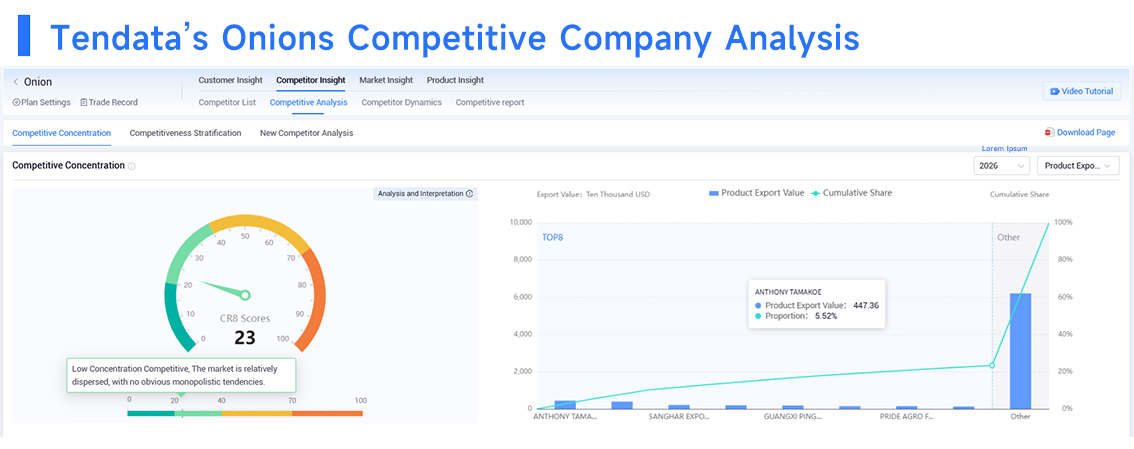
>>> Tendata’s Onions Competitive Company Analysis <<<
The Third Value of Trade Data: Finding Buyers and Reaching Decision-Makers Directly
Customer development remains one of the most difficult parts of international trade. Even after identifying buyers through trade data, many companies still face two major problems: determining whether the buyer is truly valuable and finding the right decision-maker contact information.
Professional trade data platforms help solve both problems at the same time. For example, Tendata’s iTrader V6.0 platform not only helps businesses identify high-quality buyers through global trade data, but also analyzes procurement behavior such as purchase frequency, average order volume, and purchasing cycles. These insights help exporters focus their efforts on buyers with real purchasing potential.
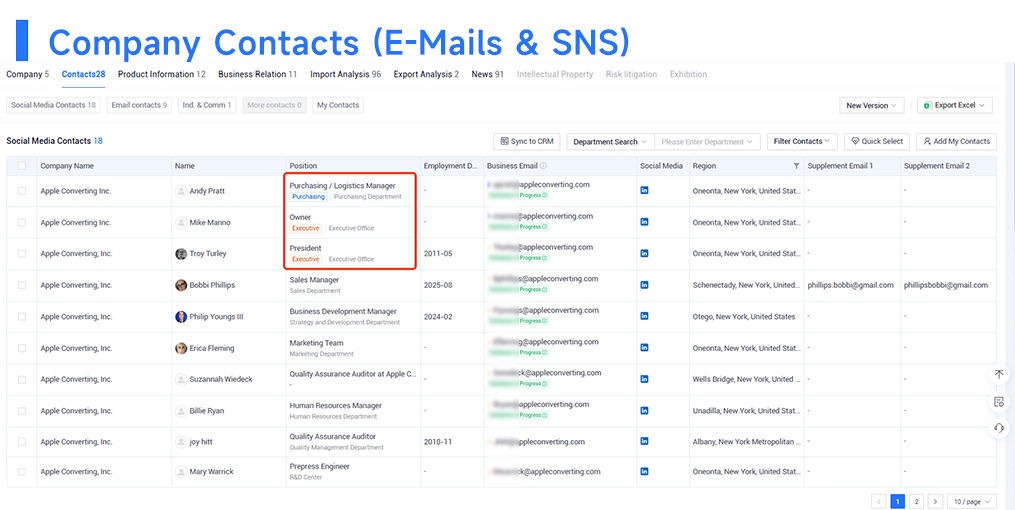
More importantly, Tendata integrates a massive database of verified email addresses, LinkedIn accounts, Facebook accounts, and other contact information connected directly to purchasing managers and decision-makers. Once a buyer is identified through trade data, businesses can immediately begin outreach without spending additional time searching for the right contacts manually.
With efficient use of trade data, companies no longer rely on “finding a needle in a haystack.” Instead, they create a complete workflow from buyer identification to direct communication.
>>> Obtaining Customer Contact Information from Tendata <<<
Inefficient vs Efficient Use of Trade Data
Many companies still use trade data inefficiently. They rely on single-source information, analyze only their own product records, ignore market trends, manually clean large amounts of disorganized data, and use basic search tools without deeper analysis. In many cases, businesses can identify buyer company names but still cannot find valid contact details. Although this approach may appear inexpensive, the hidden costs in time, labor, and missed opportunities are extremely high.
Efficient use of trade data is completely different. Using Tendata as an example, businesses can access trade data from 228 countries, business data from 198 countries, and internet data from 172 countries. The platform also provides 850 million company profiles, 10+ billion trade records, built-in decision-maker contact databases, competitor monitoring tools, cleaned and de-duplicated records, freight forwarder filtering, and the AI-powered iTrader V6.0 SaaS platform that integrates market analysis, customer development, competitor monitoring, and CRM management into one ecosystem.
The difference is not simply about “having data.” It is about whether businesses can transform trade data into real market insight and faster business growth.
About Tendata iTrader V6.0
Through the Tendata iTrader V6.0 Platform, Tendata integrates more than 10 billion global trade records, 850 million company profiles, 500 million in-depth enterprise records, and massive verified contact databases into one complete trade data solution.
The platform helps businesses analyze global demand trends, monitor competitor pricing and shipment activity, identify high-quality buyers, understand procurement behavior, and directly reach purchasing decision-makers. By combining AI-powered analysis with global trade data, Tendata helps exporters turn data into decisions and decisions into orders.
Summary
The real value of trade data does not come from the data itself. It comes from how businesses use it. If companies only use trade data to search for buyers, they may unlock only a small portion of its true value. High-level use of trade data means treating it as a market navigation system, a competitor monitoring tool, and a customer acquisition engine at the same time.
Effective trade data usage helps businesses understand global market direction, monitor competitor movements, identify high-potential buyers, reach decision-makers directly, and improve overseas market expansion efficiency.
Tendata iTrader V6.0 was built around this concept. It is not simply a database platform. It is a complete ecosystem that transforms trade data into actionable business growth.
Do not let your trade data remain unused inside spreadsheets. Start using data-driven strategies to accelerate your global business expansion today.
Category
Leave Message for Demo Request or Questions