
How to Find China Export Data?
 Export News
 2025-12-05
Finding reliable China export data can be challenging. Many assume that China publishes detailed, shipment-level export information in a public database—but in reality, China does not make granular export records publicly available. Instead, analysts must reconstruct China export data indirectly using partner countries' import statistics, shipping manifests, and commercial trade data providers.
Below is a clear guide on how to access and interpret China export data, why the data must be obtained indirectly, and how a trade-data platform like Tendata can help.

Why China Export Data Is Not Public
China releases aggregated monthly and annual trade statistics—total exports by category, destination, and overall balance. However, shipment-level China export data, which would include exporters, consignees, volumes, and bills of lading, is not disclosed publicly.
Reasons include:
1. Confidentiality: Exporter and buyer information is commercially sensitive.
2. Security & regulatory restrictions: Detailed customs data is restricted by policy.
3. Aggregation practices: China Customs primarily publishes macro statistics, not transactional records.
As a result, anyone who needs detailed China export data must rely on other countries' import records and commercial data compilers.
How China Export Data Is Reconstructed
1. Mirror Statistics (Partner Countries' Import Data)
Most detailed China export data is reconstructed using mirror statistics. Countries such as the U.S., EU members, and many Latin American economies publish detailed customs import data. Their “imports from China” serve as a mirror of China’s “exports to them.”
2. Multilateral & National Aggregate Databases
Databases like UN Comtrade or national statistical portals provide macro-level China export data, useful for trend analysis but limited for shipment-level detail.
3. Shipping & Bill-of-Lading Data
Carrier records and port manifests provide granular insights into actual shipments and logistics patterns.
4. Commercial Trade Data Providers
Because combining all these data sources manually is time-consuming, companies often rely on platforms that aggregate and clean global customs data, including indirect China export data.
Recommended Trade Data Provider
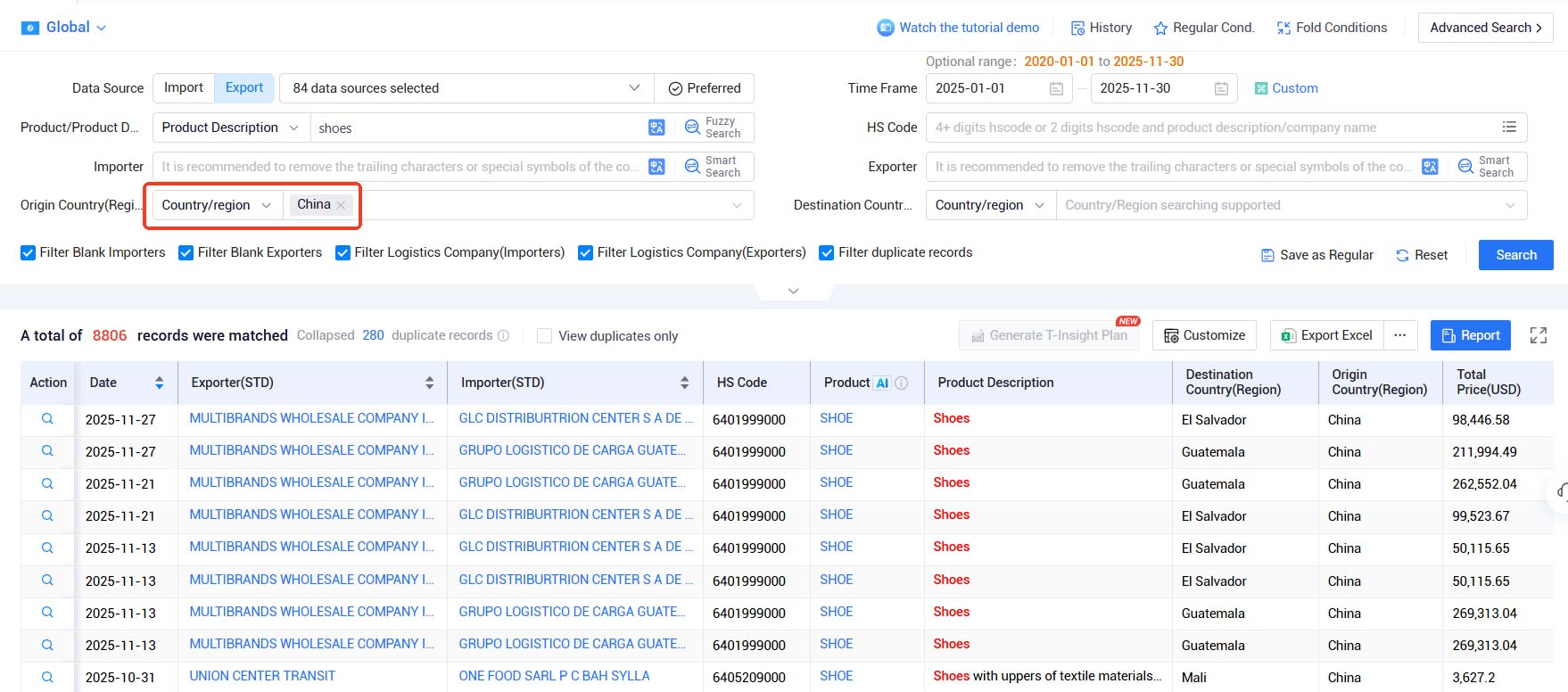
Among commercial trade-data services, Tendata is a strong option for users seeking accurate and accessible China export data reconstructed from global sources.
Why Tendata is useful:
1. Expertise in mirror-data aggregation: Tendata integrates partner-country import data, shipping manifests, and customs summaries to build reliable China export data models.
2. Cleaned & standardized datasets: Company matching, HS code harmonization, and valuation adjustments reduce manual work.
Searchable interface & API: Enables quick lookup of HS codes, routes, buyers, and suppliers.
3. Visualization & export tools: Supports reports, Excel downloads, and dashboards.
If you need reconstructed China export data for market research, competitor monitoring, or supply-chain mapping, Tendata is a practical starting point.
>>Get A Free Demo<<
Conclusion
Because shipment-level China export data is not publicly released by China, researchers rely on mirror statistics, shipping manifests, and commercial data providers. For users needing accurate, cleaned, and ready-to-use datasets, Tendata offers a strong solution by integrating global customs and shipping information into a unified platform.
Category
Leave Message for Demo Request or Questions