
Top 10 American Textile Export by Country & Company & Products-Tendata
 Export News
 2026-04-01
Keypoints
·Raw materials dominate export structure, especially cotton (HS 520100), which accounts for the largest share, reinforcing the U.S. advantage as a major global cotton supplier and a key driver of american textile export competitiveness.
·Recycling and second-hand textile trade are rapidly growing, with categories like worn clothing (HS 630900) taking a significant share, indicating a shift toward circular economy and sustainable textile export models.
·Technical and high-value textile segments are expanding, including aramid fibres, coated fabrics, and synthetic filament products, positioning american textile export strongly in innovation-driven markets such as industrial and medical textiles.
·Export destinations are highly diversified, covering both manufacturing hubs (Pakistan, Vietnam, Bangladesh) and developed consumption markets (France, Japan, Italy), reflecting a dual supply chain structure.

Overview of American Textile Export Market
The global textile export industry plays a vital role in supporting apparel manufacturing, industrial production, consumer goods, and emerging sectors such as technical and sustainable textiles. From raw materials like cotton and synthetic fibres to high-value functional fabrics and finished garments, textile exports are a key driver of international trade and economic development. Within this ecosystem, american textile export holds a strategic position, particularly in supplying high-quality cotton, advanced fibres, and innovation-driven textile products to global markets.
American Textile Export Data: 2025 Analysis
According to Tendata global trade data and industry benchmarks, the textile export market continues to demonstrate stable cross-border demand supported by diversified sourcing and industrial applications. In this segment, there are 287 active exporters supplying to 98 destination countries, generating a total of 2,062 trade transactions, which indicates a relatively concentrated yet consistent export structure with repeat shipment patterns and long-term buyer relationships.
List of Major Textile Exporting HS Codes
According to Tendata global trade data, here is the list of top textile HS Codes in 2025
1.HS Code:520100(26.66%):Cotton, neither carded nor combed
2.HS Code:630900(21.26%):Worn clothing and clothing accessories, blankets and travelling rugs, household linen and articles for interior furnishing, of all types of textile materials, incl. all types of footwear and headgear, showing signs of appreciable wear
3.HS Code:470321(4.60%):Semi-bleached or bleached coniferous chemical wood pulp, soda or sulphate (excl. dissolving grades)
4.HS Code:550311(1.87%):Staple fibres of aramids, not carded, combed or otherwise processed for spinning
5.HS Code:550120(1.07%):Filament tow as specified in Note 1 to chapter 55, of polyesters
6.HS Code:621790(1.04%):Parts of garments or of clothing accessories, of all types of textile materials, n.e.s. (excl. knitted or crocheted)
7.HS Code:590700(0.99%):Impregnated, coated or covered textile fabrics; painted canvas being theatrical scenery, studio backcloths or the like, n.e.s.
8.HS Code:550510(0.98%):Waste of synthetic staple fibres, incl. noils, yarn waste and garnetted stock
9.HS Code:470790(0.90%):Recovered "waste and scrap" paper or paperboard, incl. unsorted waste and scrap (excl. waste and scrap of unbleached kraft paper or kraft paperboard, or of corrugated paper or corrugated paperboard)
10.HS Code:631010(0.85%):Used or new rags, scrap twine, cordage, rope and cables and worn-out articles thereof, of textile materials
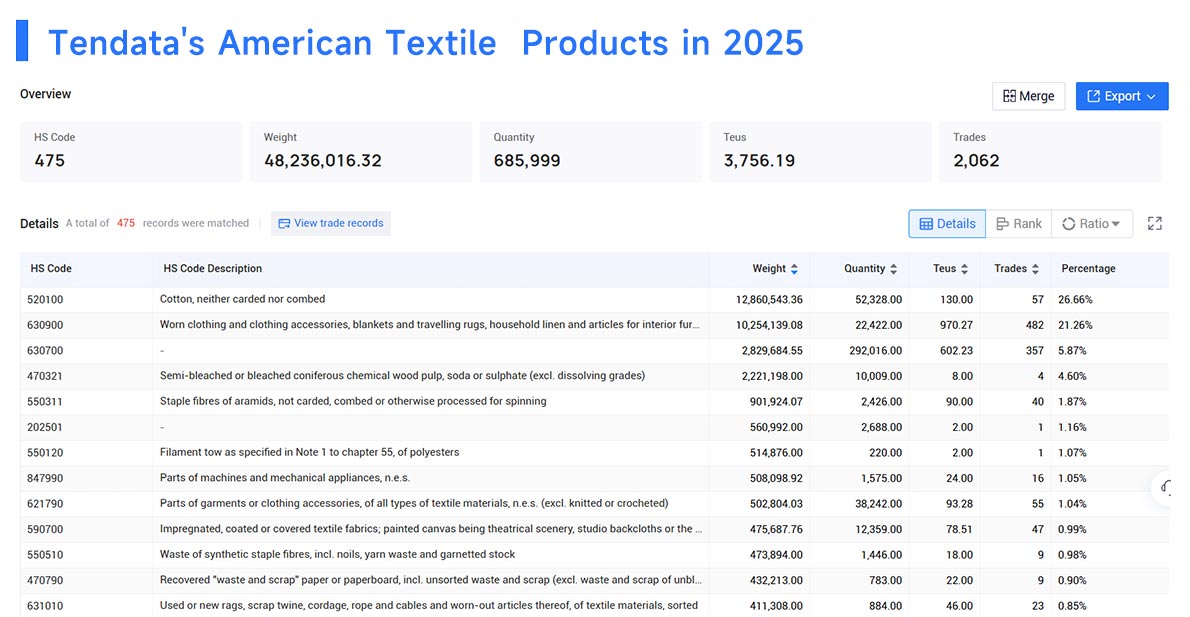
According to Tendata global trade data, the structure of textile export can be clearly understood through key HS code segments, which reflect both raw material supply and downstream recycling demand. Among these, HS Code 520100 (26.66%)—cotton, neither carded nor combed—dominates the export landscape, highlighting the critical role of raw cotton in global textile manufacturing. This is followed by HS Code 630900 (21.26%), covering worn clothing and used textile articles, indicating a strong secondary market driven by recycling, resale, and circular economy trends.
Beyond these core categories, mid-tier segments such as chemical wood pulp (HS 470321, 4.60%) and aramid staple fibres (HS 550311, 1.87%) demonstrate the growing importance of industrial and technical textiles, while polyester filament tow (HS 550120, 1.07%) reflects the continued expansion of synthetic fibre demand. Additional categories—including garment parts (HS 621790), coated fabrics (HS 590700), and textile waste products (HS 550510, HS 631010)—further illustrate the complexity of the textile value chain, spanning raw materials, semi-finished inputs, and recycling streams.
Within this diversified structure, american textile export plays a significant role, particularly in high-quality raw cotton, advanced fibres, and technical textile materials. The United States leverages its strong agricultural base and innovation capabilities to supply both upstream raw materials and high-performance textile inputs to global markets. Overall, the HS code distribution highlights a dual-driven industry: one anchored in bulk raw material exports, and the other increasingly shaped by sustainability, recycling, and high-value textile innovation.
Top textile exporting Countries
According to Tendata global trade data, below is the list of major textile exporting countries in 2025:
1.Pakistan(24.74%)
2.France(13.59%)
3.Vietnam(9.99%)
4.Bangladesh(5.98%)
5.India(4.78%)
6.Japan(4.14%)
7.South Korea(3.60%)
8.Ecuador(2.86%)
9.Italy(2.56%)
10.Slovenia(2.22%)
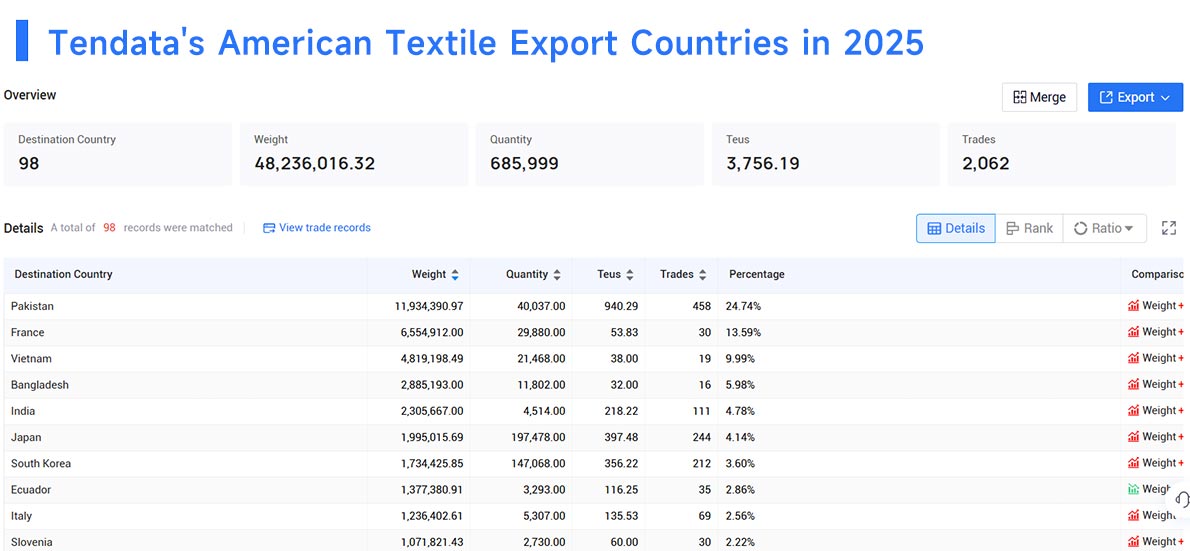
According to Tendata global trade data and aligned with global textile trade patterns, the current textile export landscape shows a clear concentration of demand across key manufacturing and consumption hubs. Among the top destination markets, Pakistan (24.74%), France (13.59%), and Vietnam (9.99%) lead the ranking, followed by Bangladesh, India, Japan, and South Korea, indicating strong linkages with both garment manufacturing bases and developed consumer markets. Secondary markets such as Ecuador, Italy, and Slovenia further reflect the diversified geographic spread of textile trade flows.
From a global perspective, the textile industry remains highly competitive and interconnected, with supply chains spanning Asia, Europe, and the Americas. Within this structure, american textile export continues to play a pivotal role as the United States ranks among the world’s leading textile exporters, with exports reaching approximately $28 billion in 2024 and maintaining its position as one of the top global suppliers of high-value textile products.
Top American Textile Exporters in 2025
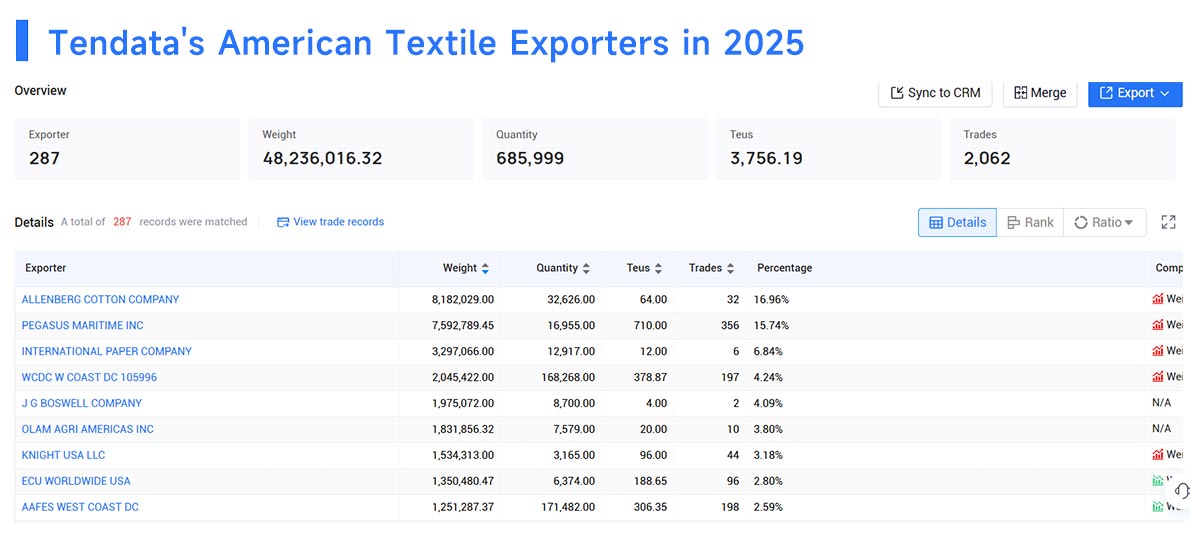
According to Tendata global trade data, here is the list of top textile exporters in Aemerica in 2025:
1.ALLENBERG COTTON COMPANY(16.96%)
2.PEGASUS MARITIME INC(15.74%)
3.INTERNATIONAL PAPER COMPANY(6.84%)
4.WCDC W COAST DC 105996(4.24%)
5.J G BOSWELL COMPANY(4.09%)
6.OLAM AGRI AMERICAS INC(3.80%)
7.KNIGHT USA LLC(3.18%)
8.ECU WORLDWIDE USA(2.80%)
9.AAFES WEST COAST DC(2.59%)
10.INFINITE RAGS EXPORTS INC(2.40%)
How to find Textile Products Export Data?
When it comes to analyzing textile export opportunities, the methodology is highly consistent with how professionals track chemical trade flows—starting from HS code identification, followed by data sourcing, and finally actionable market analysis. The first step is to define the relevant textile HS codes (such as cotton, synthetic fibres, or garments), ensuring accurate filtering of global trade flows. Then, users can leverage official sources like customs databases or international platforms such as UN Comtrade for macro trends, while more advanced platforms provide deeper insights.
However, for businesses aiming to scale in competitive sectors like american textile export, high-level statistics are not sufficient. Platforms like Tendata enable users to directly search textile export data by product name or HS code across 228+ countries, providing granular shipment-level details such as importer/exporter names, trade frequency, pricing, and destination markets. This allows exporters to move beyond “market research” into precise customer development, identifying which buyers are actively purchasing textiles, how often they reorder, and which suppliers they currently rely on.
More importantly, Tendata supports a full decision-making workflow: users can identify high-potential markets, track competitor export routes, analyze demand cycles, and obtain verified contact information for direct outreach. In the context of american textile export, this means U.S. exporters can pinpoint global buyers with consistent procurement behavior, optimize pricing strategies based on real transaction data, and align supply chains with high-growth regions. Ultimately, combining structured HS code analysis with Tendata’s transaction-level intelligence transforms textile export from broad market exploration into a data-driven, conversion-oriented growth strategy.
Final Words
American textile export continues to hold strategic importance. The United States remains one of the world’s leading textile exporters, with exports reaching around $28 billion in 2024 and maintaining its position as a top global supplier, particularly in high-value fibres, technical textiles, and advanced materials . This positions U.S. exporters not just as volume players, but as key contributors to innovation-driven segments of the global textile value chain.
FAQ:Textile Export & Tendata Insights
1.How does Tendata help identify real textile buyers and opportunities?
Tendata provides transaction-level trade data across 200+ countries, allowing users to directly access real importer/exporter names, shipment volumes, prices, and trading frequency. Instead of relying on aggregated statistics, businesses can pinpoint active buyers in textile export markets, track their sourcing patterns, and identify high-potential leads for faster conversion.
2. Can Tendata support american textile export strategy optimization?
A: Yes. For companies involved in american textile export, Tendata enables precise market targeting by revealing which countries are consistently importing U.S. textiles, what products are in demand (e.g., cotton, industrial fabrics), and how competitors are positioned. This helps exporters optimize pricing, adjust product mix, and prioritize markets with stable procurement cycles.
3.What type of textile export data can be accessed through Tendata?
A: Users can access detailed datasets including HS codes, shipment records, buyer/supplier names, quantities, values, and trade timelines. This level of granularity is especially useful in textile export, where supply chains are complex and buyer behavior varies significantly across regions.
Category
Leave Message for Demo Request or Questions