
Top 10 Global Golden Export by Country & Company & Products-Tendata
 Export News
 2026-04-01
Keypoints
· The global golden export market has emerged as one of the most dynamic and high-value segments in international trade, driven by strong investment demand, price surges, and increasing geopolitical uncertainty. In 2025, global gold demand exceeded 5,000 tons for the first time, with total market value reaching record levels and gold prices hitting multiple all-time highs .
· The golden export market is characterized by high value concentration and strong liquidity, with tens of thousands of exporters and over 200 destination countries involved.
· Gold exports are increasingly value-added, with jewellery-related HS codes accounting for a significant share of trade value, reflecting strong demand in luxury and consumer markets.

Overview of Global Golden Export Market
The global golden export market plays a vital role in supporting financial systems, investment markets, jewellery manufacturing, and industrial applications worldwide. From raw gold and unwrought materials to high-value jewellery and refined products, gold exports drive international trade flows and capital movement across both developed and emerging economies.
Global Golden Export Data: 2025 Analysis
The global golden export market in 2025 demonstrates exceptional scale and strategic importance, driven by strong investment demand, rising prices, and increasing geopolitical uncertainty. According to available global trade data, gold exports reached a total value of $132.79 billion, supported by 28,430 exporters, spanning 221 destination countries and generating over 1.35 million trade transactions. This highlights gold’s dual role as both a high-value traded commodity and a financial safe-haven asset within international markets.
List of Major Gold Exporting HS Codes
According to Tendata global trade data, here is the list of top gold HS Codes in 2025
1.HS Code:71131990(6.45%, $8.57 Billion):Articles of jewellery and parts thereof, of precious metal other than silver, whether or not plated or clad with precious metal
2.HS Code:71131911(6.19%, $8.22 Billion):Jewellery & parts thereof of gold, plated with diamonds mounted
3.HS Code:71081200(1.79%, $2.38 Billion):Gold, including gold plated with platinum, unwrought, for non-monetary purposes (excluding gold in powder form)
4.HS Code:71081290(1.25%, $1.66 Billion):Gold, incl. gold plated with platinum, unwrought, for non-monetary purposes (excl. gold in powder form)
5.HS Code:71131919(1.17%, $1.56 Billion):Jewellery & parts thereof of gold, n.e.s.
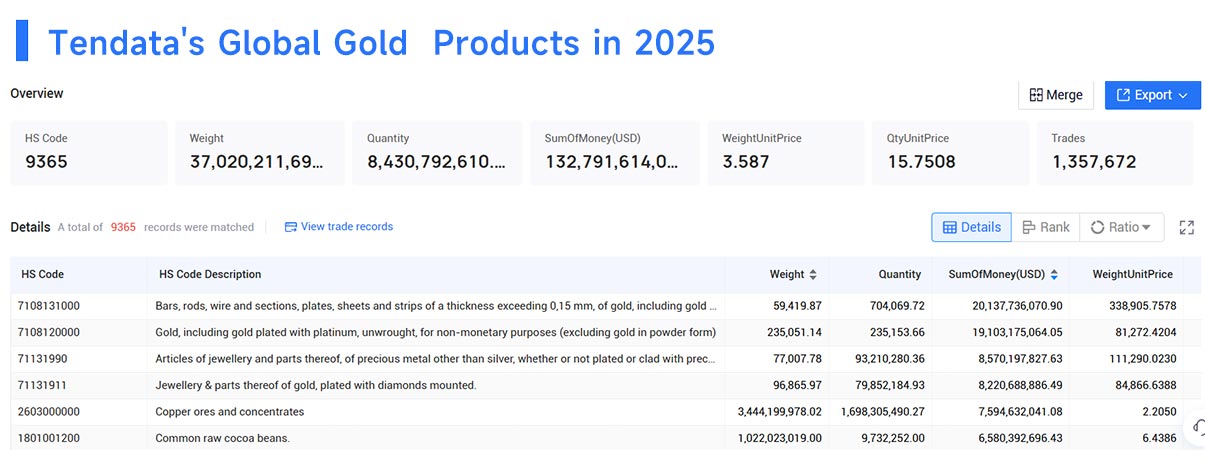
According to Tendata global trade data, the structure of the golden export market in 2025 is heavily concentrated in high-value jewellery and semi-processed gold products, reflecting strong downstream demand in luxury consumption and investment sectors. Among the leading categories, HS Code 71131990 dominates with 6.45% ($8.57 billion), covering jewellery and parts of precious metals, indicating that finished and semi-finished gold products account for a significant share of global trade value.
Closely following is HS Code 71131911 at 6.19% ($8.22 billion), highlighting the strong market for diamond-mounted gold jewellery, which underscores the premiumization trend in global gold consumption. In contrast, upstream raw material categories such as HS Code 71081200 (1.79%, $2.38 billion) and 71081290 (1.25%, $1.66 billion) represent unwrought gold for non-monetary purposes, serving as key inputs for refining, manufacturing, and investment-grade products.
Additionally, HS Code 71131919 (1.17%, $1.56 billion) further reflects diversified jewellery exports beyond standardized classifications. Overall, the HS code distribution reveals that the golden export market is not only driven by raw gold supply but is increasingly shaped by value-added processing, jewellery manufacturing, and luxury trade flows, providing exporters with higher-margin opportunities across global markets.
Top Gold Exporting Countries
According to Tendata global trade data, below is the list of major gold exporting countries in 2025:
1.United Arab Emirates (19.77%, $26,253.39 Million)
2.Switzerland (12.73%, $16,898.30 Million)
3.United States (10.29%, $13,667.54 Million)
4.India (8.22%, $10,917.94 Million)
5.China (7.07%, $9,383.68 Million)
6.Canada (4.38%, $5,810.43 Million)
7.South Africa (4.37%, $5,797.45 Million)
8.Singapore (3.64%, $4,839.92 Million)
9.Hong Kong, China (2.58%, $3,420.53 Million)
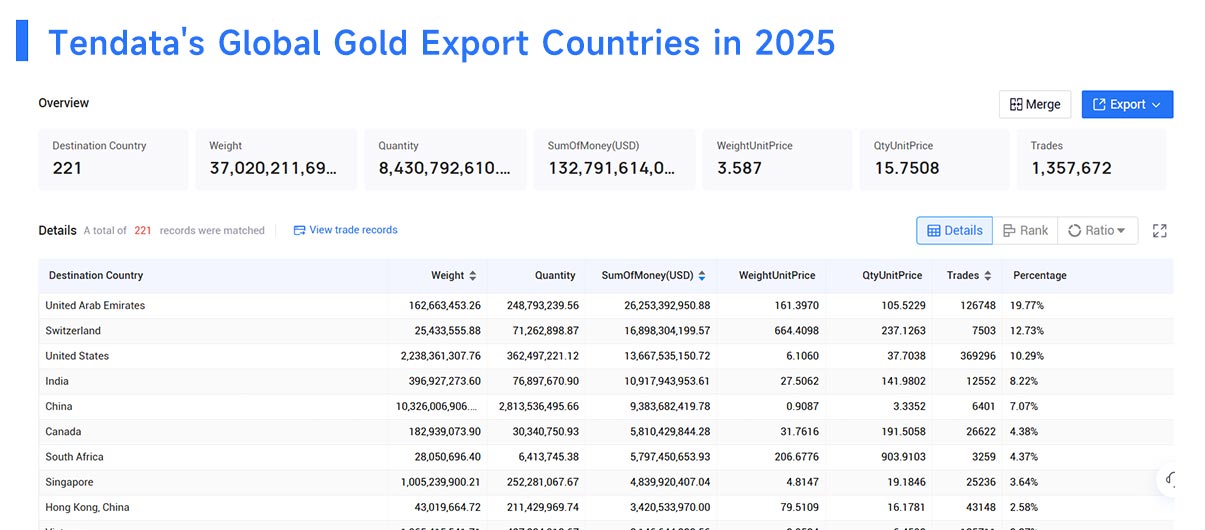
According to Tendata global trade data, the gold exporting landscape in 2026 continues to reflect a highly concentrated yet globally interconnected market structure. The United Arab Emirates leads as the dominant hub, accounting for 19.77% ($26,253.39 million) of total exports, driven by its role as a major global trading and re-export center. Switzerland follows with 12.73% ($16,898.30 million), leveraging its advanced refining industry and strong financial ecosystem.
The United States (10.29%), India (8.22%), and China (7.07%) also rank among the top gold exporting countries, highlighting the combined influence of mining capacity, domestic demand cycles, and re-export activities. Meanwhile, resource-rich nations such as Canada (4.38%) and South Africa (4.37%) continue to play a critical role as primary gold producers in the global supply chain.
Additionally, key trade hubs including Singapore (3.64%) and Hong Kong, China (2.58%) further reinforce Asia’s growing importance in gold distribution and financial trading. Overall, the 2026 gold exporting market is characterized by a dual structure of production-driven exporters and trade-driven hubs, reflecting both upstream resource control and downstream financial and logistics advantages in the global gold trade ecosystem.
Top Global Gold Exporters in 2025
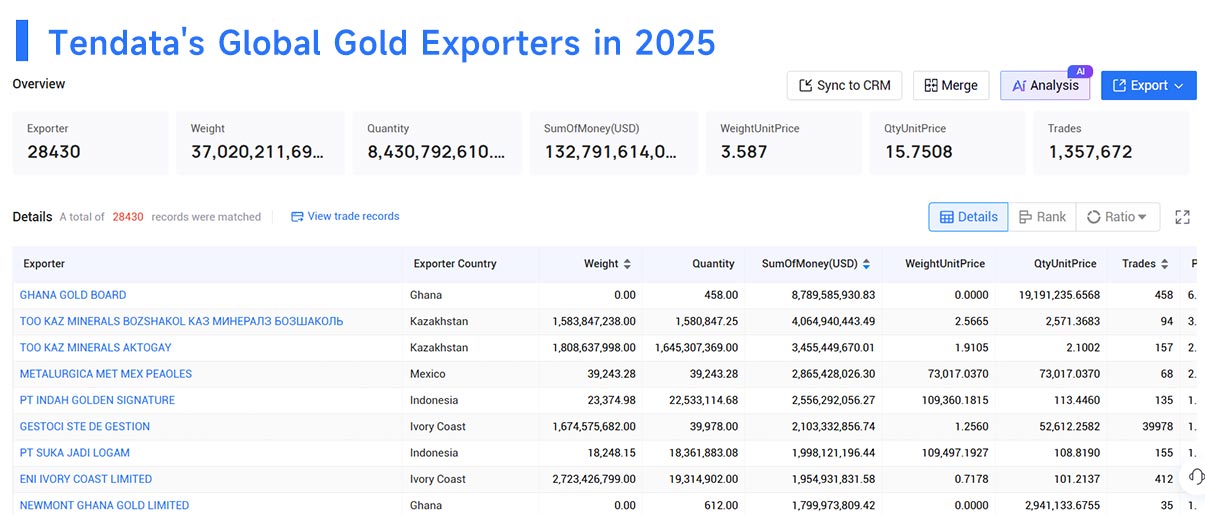
According to Tendata global trade data, here is the list of top gold exporters worldwide in 2025:
1.GHANA GOLD BOARD (6.62%, $8,789.59 Million)
2.TOO KAZ MINERALS BOZSHAKOL KAZ MINERALS BOZSHAKOL (3.06%, $4,064.94 Million)
3.TOO KAZ MINERALS AKTOGAY (2.60%, $3,455.45 Million)
4.METALURGICA MET MEX PEAROLES (2.16%, $2,865.43 Million)
5.PT INDAH GOLDEN SIGNATURE (1.93%, $2,556.29 Million)
6.GESTOCI STE DE GESTION (1.58%, $2,103.33 Million)
7.PT SUKA JADI LOGAM (1.50%, $1,998.12 Million)
8.ENI IVORY COAST LIMITED (1.47%, $1,954.93 Million)
9.NEWMONT GHANA GOLD LIMITED (1.36%, $1,799.97 Million)
How to find Gold Products Export Data?
To effectively analyze the golden export market, businesses need access to accurate, granular, and up-to-date trade data. Similar to how chemical trade data is sourced and analyzed, gold export data can be obtained through specialized global trade intelligence platforms that aggregate customs records, shipment data, and statistical databases. These datasets typically include key dimensions such as HS codes, exporter/importer names, shipment values, quantities, and destination countries, enabling a comprehensive view of global trade flows.
With Tendata, users can streamline this process through an integrated data platform. By simply entering relevant gold HS codes (such as 7108 or 7113) or product keywords, users can instantly access detailed golden export records, including top exporting countries, active buyers, transaction frequency, and price trends. The platform also allows users to filter by country, time period, and company, helping identify high-value markets and stable buyers with consistent purchasing behavior.
More importantly, Tendata goes beyond basic data retrieval. It enables users to analyze trade patterns, compare competitors, and uncover potential clients by leveraging multi-source data integration and AI-driven insights—similar to leading trade data platforms that provide searchable global import-export databases and analytics tools.
Final Words
In conclusion, the global golden export market continues to stand out as one of the most valuable and strategically significant segments in international trade. Driven by record-high prices, strong central bank demand, and increasing investor interest, gold has experienced unprecedented growth in both value and trading activity in recent years . This evolving landscape highlights not only the importance of gold as a commodity but also its role as a financial asset and risk-hedging instrument in a volatile global economy.
For businesses engaged in the golden export sector, success increasingly depends on data-driven decision-making. This is where Tendata delivers clear value. By providing access to real-time global trade data—including exporter networks, active buyers, transaction frequency, and pricing trends—Tendata enables companies to move beyond surface-level insights and identify high-potential markets and reliable partners.
FAQ
1. How can I find reliable buyers in the golden export market?
With Tendata, users can search by gold HS codes (e.g., 7108, 7113) or product keywords to access real customs shipment data. The platform allows you to identify active importers, repeat buyers, purchasing frequency, and supplier relationships, ensuring you target customers with stable and ongoing demand rather than one-time transactions.
2. What insights can golden export data provide for business decisions?
Analyzing golden export data enables companies to track market trends, price fluctuations, trade flows, and demand shifts across countries. It also helps uncover high-growth markets and evaluate competitor performance, which is critical in a high-value and price-sensitive commodity like gold.
3. How does Tendata improve gold export analysis compared to traditional methods?
Traditional trade data sources are often fragmented or limited in coverage, while Tendata integrates multi-country customs data and business intelligence into one platform. This allows users to conduct **end-to-end analysis—from market overview to buyer identification and risk assessment—**making the golden export process more efficient and data-driven.
Category
Leave Message for Demo Request or Questions