
Top 10 Canadas Main Exports of Food by Country & Company & Product- Tendata
 Export News
 2026-04-02
Keypoints
·Strong global export scale: Canadas main exports of food reached nearly $8.94 billion across 149 destination countries and over 24,000 transactions, reflecting a stable and well-established global trade network.
·Concentration with gradual diversification: While the United States remains the dominant destination (accounting for the majority share), canadas main exports are increasingly expanding into Asia and Europe, including markets like China, Japan, and the Netherlands.
·Value-added export structure: A significant portion of exports comes from processed and high-value food products (e.g., prepared foods, cocoa-based products), indicating a shift from raw commodities to higher-margin goods

The global food export sector plays a vital role in supporting food security, consumer demand, and economic development across international markets. From staple agricultural goods to high-value processed and packaged foods, canadas main exports contribute significantly to global supply chains and trade flows. With strong production capacity and advanced food processing capabilities, Canada has established itself as a competitive player in the international agri-food industry.
Canadas Main Exports Data: 2025 Overview
According to Tendata Canada trade data, canadas main exports of food in 2025 demonstrate a stable and moderately diversified global trade structure. The market involves exports to 149 destination countries, generating a total export value of $8.94 billion across 24,657 trade transactions, reflecting both scale and consistency in international food supply. This aligns with Canada’s broader agri-food sector performance, which has surpassed $100 billion in total exports, highlighting its critical role in global food trade and economic contribution .
List of Canadas Main Exporting HS Codes of Food
According to Tendata Canada trade data, here is the list of main food HS Codes in 2025:
1.HS Code:2106909000(21.45%, $1.92 Billion):Other fruit and other edible parts of plant, other than subheading
2.HS Code:1806200000(21.10%, $1.89 Billion):Cocoa, prepared or preserved (excl. confectionery chocolate, flake)
3.HS Code:1806909000(10.34%, $0.92 Billion):Chocolate and other preparations containing cocoa
4.HS Code:1806320000(8.44%, $0.75 Billion):Cocoa, prepared or preserved (excl. cocoa butter, cocoa paste)
5.HS Code:1901900000(7.12%, $0.64 Billion):Other food preparations of flour (cocoa <40%) / milk
6.HS Code:2309101000(6.23%, $0.56 Billion):Dog or cat food, put up for retail sale; containing meat
7.HS Code:1806310000(5.87%, $0.52 Billion):Cocoa preparations, in blocks, slabs or bars, filled
8.HS Code:2309109000(5.39%, $0.48 Billion):Dog or cat food, for retail sale
9.HS Code:8419810000(5.25%, $0.47 Billion):Machinery, plant and equipment for making hot drinks or for cooking
10.HS Code:1904100000(4.06%, $0.36 Billion):Prepared foods obtained by swelling or roasting cereals
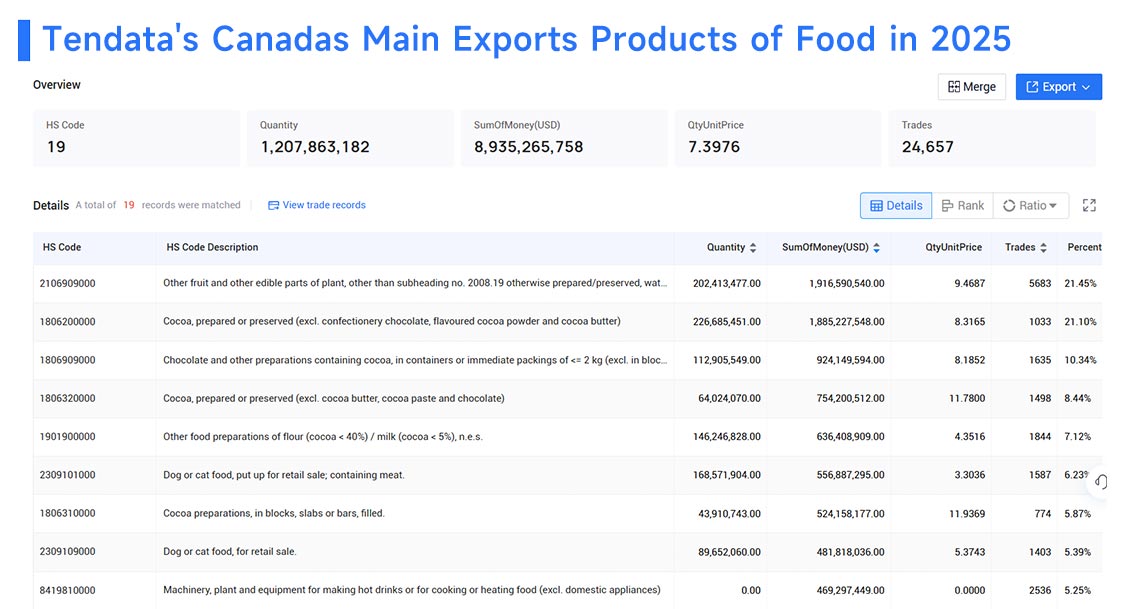
According to Tendata Canada trade data, canadas main exports of food in 2025 demonstrate a strong concentration in processed food products and cocoa-based commodities, reflecting the country’s advanced food manufacturing and value-added export capabilities. Among the leading categories, HS Code 2106909000 (other edible plant-based food preparations) accounts for the largest share at 21.45% ($1.92 billion), followed closely by HS Code 1806200000 (prepared cocoa products) at 21.10% ($1.89 billion). In addition, chocolate and cocoa-related products—including HS Codes 1806909000 and 1806320000—collectively contribute a significant portion of export value, highlighting Canada’s competitive position in confectionery and processed cocoa segments. Other notable categories within canadas main exports include food preparations of flour and milk (HS 1901900000), pet food products (HS 2309101000 and 2309109000), and cereal-based processed foods (HS 1904100000). Overall, the export structure indicates a shift toward high-margin, processed food items rather than raw agricultural commodities, reinforcing Canada’s role as a key supplier of diversified, value-added food products in the global market.
Food Canadas Main Exporting Countries
According to Tendata Canada trade data, below is the list of major food exporting countries in 2025:
1.United States(84.34%, $7.54 Billion)
2.China(1.80%, $0.16 Billion)
3.Netherlands(1.56%, $0.14 Billion)
4.South Korea(1.44%, $0.13 Billion)
5.Mexico(1.40%, $0.12 Billion)
6.Taiwan, China(0.70%, $0.06 Billion)
7.Japan(0.61%, $0.05 Billion)
8.Australia(0.59%, $0.05 Billion)
9.Hong Kong, China(0.52%, $0.05 Billion)
10.United Kingdom(0.50%, $0.04 Billion)
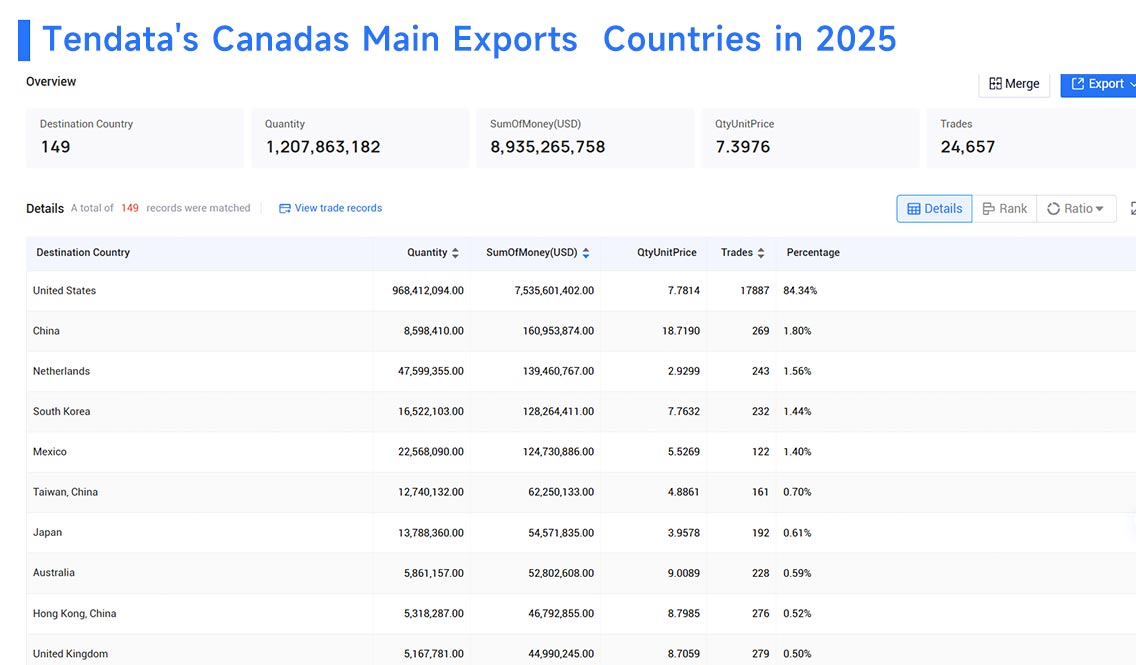
According to Tendata Canada trade data, the destination structure of canadas main exports of food in 2025 reveals a highly concentrated and North America–centric trade pattern, with the United States dominating as the primary export market. Accounting for an overwhelming 84.34% ($7.54 billion) of total export value, the U.S. remains the core driver of demand, supported by geographic proximity, integrated supply chains, and favorable trade agreements. Beyond this dominant market, canadas main exporters are also expanding into diversified global destinations, including China (1.80%), the Netherlands (1.56%), South Korea (1.44%), and Mexico (1.40%), which collectively reflect growing demand across Asia and Europe.
Additional markets such as Taiwan (China), Japan, Australia, Hong Kong (China), and the United Kingdom contribute smaller yet strategically important shares, indicating a gradual diversification trend in canadas main exports. This export distribution highlights that while Canada’s food export sector remains heavily reliant on the U.S., there is clear momentum among canadas main exporters to explore high-growth international markets, reduce dependency risks, and strengthen their global footprint through value-added and processed food products.
How to Find Food Canadas Main ExportData with Tendata?
To identify and analyze canadas main exports of food, businesses can follow a structured approach similar to how chemical trade data is sourced and interpreted. The process typically begins with accessing official trade statistics and customs-based databases, such as government platforms (e.g., Canada Trade Data Online) or global datasets like UN Comtrade, which provide product-level export data by HS Code and destination markets . These sources are built on customs declarations submitted to authorities, ensuring that the data reflects real cross-border transactions, including product classification, value, and trading partners .
For deeper insights into canadas main exporting activities, advanced trade intelligence platforms like Tendata or similar databases can be used to drill down into shipment-level records. These platforms allow users to search by HS Code, track export volumes and prices, and identify active buyers and suppliers, since customs data contains detailed information such as company names, transaction frequency, and trade routes . By combining macro-level statistics with granular shipment data, exporters can not only understand canadas main exports structure but also pinpoint high-potential markets, monitor competitor activity, and develop precise customer acquisition strategies.
Final Words
In conclusion, canadas main exports of food highlight the country’s strong position as a global agri-food supplier, driven by both high-volume production and increasing value-added processing capabilities. Canada exports over half of its agricultural and food production annually and ranks among the world’s top exporters in this sector, reflecting its critical role in global food supply chains . However, the export structure remains highly concentrated, with a significant share directed toward the United States, while other markets such as China, the Netherlands, and Japan continue to gain importance .
For businesses aiming to identify opportunities within canadas main exporters, using advanced trade intelligence platforms like Tendata becomes essential. Tendata enables users to move beyond surface-level statistics by accessing real customs shipment data, identifying active buyers, tracking procurement cycles, and analyzing competitor strategies. By combining macro trade trends with granular data insights, companies can better understand canadas main exports, uncover high-potential markets, and build precise, data-driven export strategies.
FAQ: Insight of Canadas Main Exports
1.How can Tendata help analyze canadas main exports?
Tendata provides detailed customs-based trade data that allows users to deeply analyze canadas main exports, including HS Code breakdowns, export values, and destination markets. It also enables businesses to identify active buyers, monitor shipment frequency, and evaluate market demand trends.
2.How does Tendata support finding canadas main exporters?
With Tendata, users can directly access shipment-level data to identify canadas main exporters, including company names, transaction records, and trading partners. This helps businesses quickly locate high-potential suppliers or competitors and build targeted outreach strategies based on real trade activity.
3.Why is trade data important for understanding canadas main exports?
Trade data transforms abstract market trends into actionable insights. By using platforms like Tendata, companies can move beyond basic statistics and gain a precise understanding of canadas main exports, optimize market selection, and improve customer acquisition with data-driven decision-making.
Category
Leave Message for Demo Request or Questions