
Top 10 Global Almond Exporters by Country & Company & Product- Tendata
 Export News
 2026-04-02
Keypoints
·The global almond export market is highly concentrated, with leading almond exporters such as the United States, Spain, and Australia dominating supply and accounting for over 90% of total export value, creating strong competitive barriers for new entrants.
·Almond exporters benefit from strong and growing global demand, driven by rising consumption of plant-based foods, healthy snacks, and almond-based ingredients, with the market expected to maintain steady growth in the coming years.
·Almond export flows are increasingly globalized, with shipments distributed across Europe, Asia, and the Middle East, while trade networks continue to expand beyond traditional markets into emerging regions.

The global almond export industry plays a vital role in supporting the food, health, and snack sectors across international markets. From raw almonds to processed and value-added products, almond exporters contribute significantly to global agricultural trade and economic growth. Understanding the top almond exporting countries provides valuable insight into supply concentration, consumption trends, and evolving trade dynamics. This blog explores key almond exporters based on global trade data, highlighting major exporting countries, market distribution, almond export data, and relevant HS Codes.
Almond Exporters: Data Overview of Global Almond Export
According to Tendata global trade data, the global almond export market in 2025 reflects a large-scale and highly interconnected trade network, with 3,045 almond exporters supplying to 187 destination countries, generating a total trade value of over $1.02 billion across 59,580 transactions. This indicates not only a broad geographic reach but also a high level of transaction frequency, suggesting stable and recurring global demand for almonds.
Almond Exporters: List of Major Almond Exporting HS Codes
According to Tendata global trade data, here is the list of top almond HS Codes in 2025:
1.HS Code:20081991(28.53%, $0.29 Billion):Prepared or preserved chestnuts (excl. sweetened, roasted or otherwise prepared)
2.HS Code:1513211000(15.09%, $0.15 Billion):Crude palm kernel oil
3.HS Code:20081999(3.90%, $0.04 Billion):Prepared or preserved other foods; preparations based on fruits and vegetables (excl. fruit juices, wine of fresh grapes)
4.HS Code:8041000(3.31%, $0.03 Billion):Dates, fresh or dried
5.HS Code:1513291000(2.99%, $0.03 Billion):Palm kernel and babassu oil and their fractions, whether or not refined, but not chemically modified (excluding crude)
6.HS Code:10089000(2.60%, $0.03 Billion):Cereals (excl. wheat and meslin, rye, barley, oats, maize, rice, grain sorghum, buckwheat, millet, canary seed, fonio, quinoa and triticale)
7.HS Code:19041001(2.09%, $0.02 Billion):Prepared foods obtained by swelling or roasting cereals or cereal products (e.g. cornflakes)
8.HS Code:11063000(2.08%, $0.02 Billion):Flour, meal and powder of produce of chapter 8 (excl. of cereals)
9.HS Code:8021290(1.99%, $0.02 Billion):Fresh or dried almonds, shelled (excl. bitter)
10.HS Code:2202999000(1.86%, $0.02 Billion):Other non-alcoholic beverages (excluding water, fruit or vegetable juices, milk and beer)
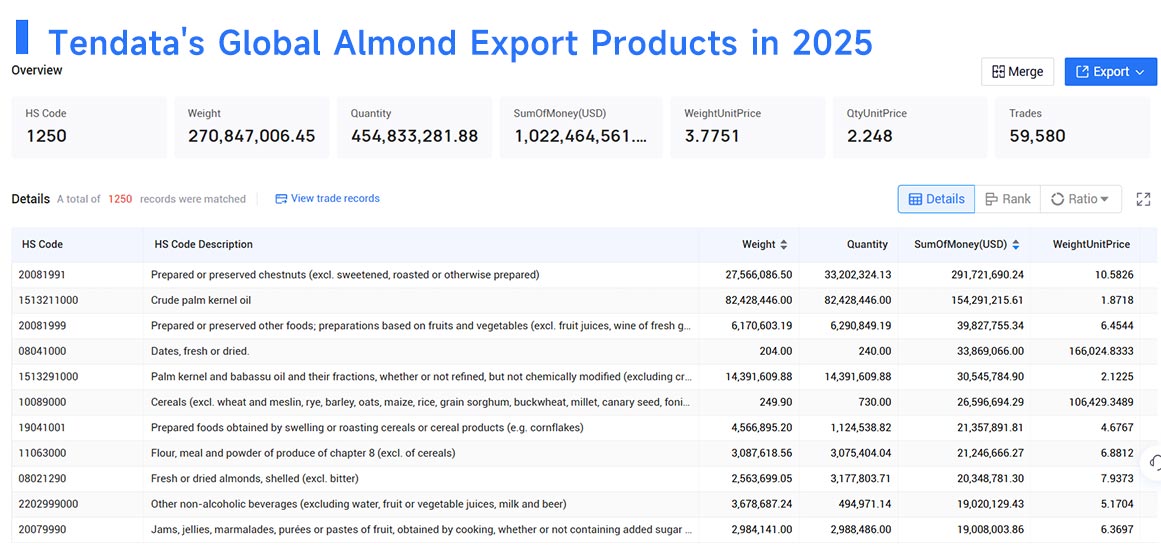
According to Tendata global trade data, the structure of almond export in 2025 can be clearly understood through key HS Codes that reflect both raw and value-added product flows. Among these, HS Code 08021290 (fresh or dried almonds, shelled) represents the core category for almond exporters, contributing a stable share of global trade with a value of approximately $0.02 billion. In addition to direct almond exportered products, related processed food categories—such as HS Code 20081991 (prepared or preserved nuts) and HS Code 20081999 (fruit and nut-based preparations)—highlight the growing trend of value-added almond exports across international markets.
This diversified HS Code distribution indicates that almond exporters are no longer limited to raw shipments but are increasingly expanding into processed and packaged segments to capture higher margins. At the same time, supporting categories like cereal preparations (HS 19041001) and plant-based powders (HS 11063000) further demonstrate how almonds are integrated into broader food supply chains. Overall, analyzing these HS Codes enables businesses to identify high-potential segments, benchmark almond exportered product performance, and uncover new opportunities in both primary and downstream markets.
Almond Exporters::Top Almond Exporting Countries
According to Tendata global trade data, below is the list of major almond exporting countries in 2025:
1.China (16.80%, $171.82 Million)
2.United States (7.98%, $81.59 Million)
3.Mexico (7.01%, $71.63 Million)
4.Singapore (6.82%, $69.74 Million)
5.Malaysia (4.41%, $45.04 Million)
6.El Salvador (3.27%, $33.46 Million)
7.Vietnam (2.78%, $28.40 Million)
8.Guatemala (2.73%, $27.93 Million)
9.Costa Rica (2.22%, $22.70 Million)
10.United Arab Emirates (2.14%, $21.89 Million)
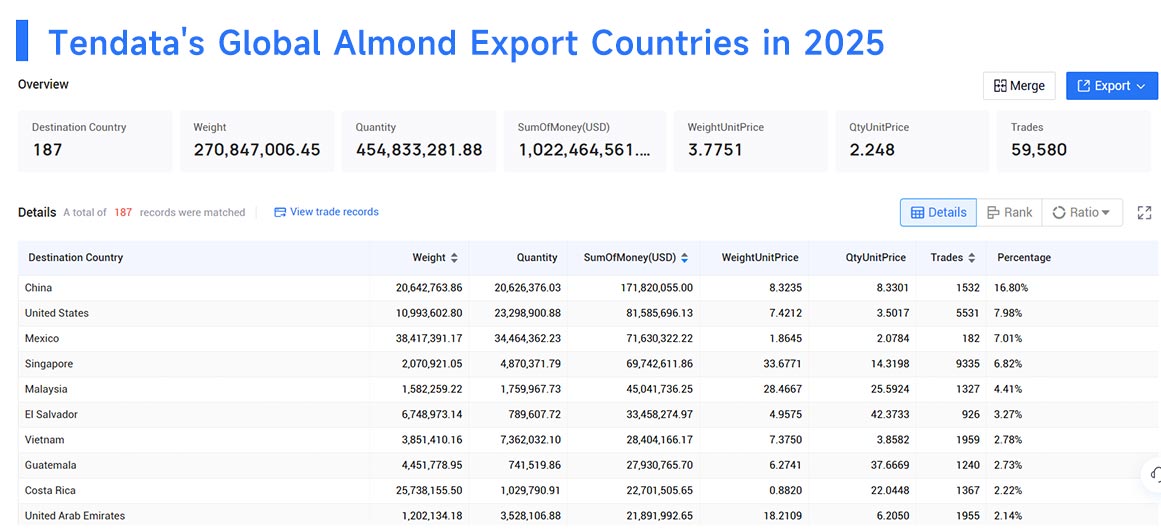
According to Tendata global trade data, the global landscape of almond export in 2025 shows a diversified yet competitive structure among leading almond exporters. China ranks as the top market contributor, accounting for 16.80% of total almond exported value at $171.82 million, followed by the United States (7.98%, $81.59 million) and Mexico (7.01%, $71.63 million). Emerging trade hubs such as Singapore (6.82%) and Malaysia (4.41%) also play a critical role, reflecting the importance of re-export and regional distribution networks in the almond trade.
In addition, countries like El Salvador, Vietnam, Guatemala, Costa Rica, and the United Arab Emirates collectively demonstrate the growing geographical spread of almond exporters, indicating increasing demand across both developed and developing markets. This distribution highlights a key trend: almond exported volumes are no longer concentrated in traditional markets alone but are expanding into Southeast Asia, Latin America, and the Middle East.
Almond Exported:Top Global Almond Exporters in 2025
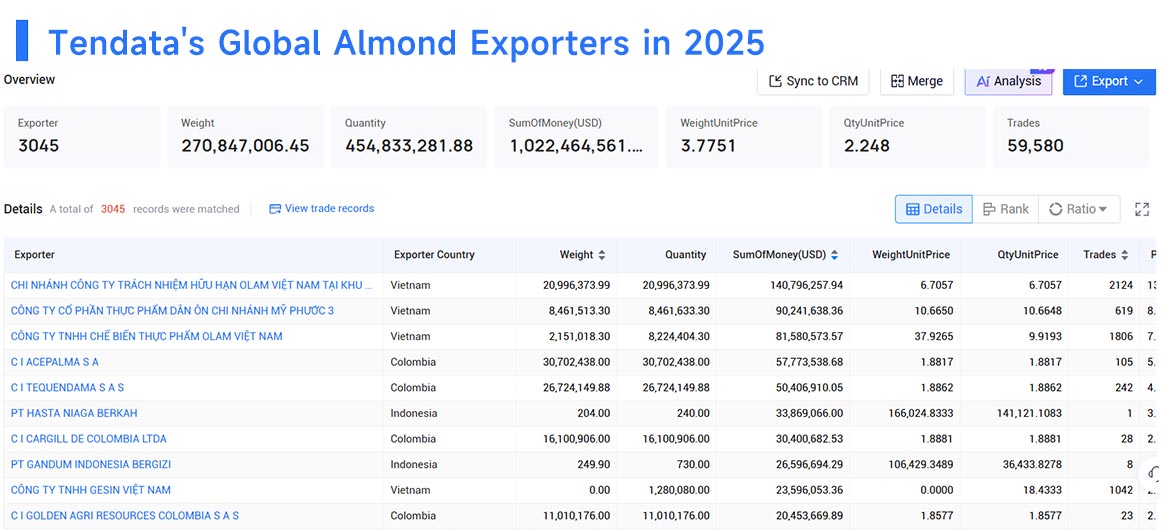
According to Tendata global trade data, here is the list of top almond exporters worldwide in 2025:
1.CHI NHÁNH CÔNG TY TRÁCH NHIỆM HỮU HẠN OLAM VIỆT NAM (13.77%, $140.80 Million)
2.CÔNG TY CỔ PHẦN THỰC PHẨM DÂN ÔN CHI NHÁNH MỸ PHƯỚC (8.83%, $90.24 Million)
3.CÔNG TY TNHH CHẾ BIẾN THỰC PHẨM OLAM VIỆT NAM (7.98%, $81.58 Million)
4.C I ACEPALMA S A (5.65%, $57.77 Million)
5.C I TEQUENDAMA S A S (4.93%, $50.41 Million)
6.PT HASTA NIAGA BERKAH (3.31%, $33.87 Million)
7.C I CARGILL DE COLOMBIA LTDA (2.97%, $30.40 Million)
8.PT GANDUM INDONESIA BERGIZI (2.60%, $26.60 Million)
9.CÔNG TY TNHH GESIN VIỆT NAM (2.31%, $23.60 Million)
How to Find Almond Export Data?
To effectively analyze and grow in the global almond export market, businesses must understand how to access and utilize reliable trade data. Similar to methods used in chemical trade analysis, almond exporters can follow a structured approach to identify high-potential markets and buyers. First, select the relevant time period and focus on specific HS Codes such as 080212 (almonds, shelled) to track almond export trends accurately. Next, filter by reporting and partner countries to evaluate where almond exporters are most active and which regions show consistent demand growth.
In addition, using global trade intelligence platforms that aggregate customs records and bill of lading data allows almond exporters to access detailed shipment-level insights, including buyer names, pricing, volumes, and destination ports. These datasets enable companies to identify active buyers, monitor competitors, and benchmark their own almond export performance against the market.
More importantly, analyzing multi-country trade data helps uncover hidden opportunities—such as emerging markets or re-export hubs—while also validating real demand through repeated transactions. For almond exporters, this means moving beyond basic statistics to actionable intelligence: identifying who is consistently importing, how frequently products are shipped, and where growth is accelerating. In today’s data-driven trade environment, mastering how to find and interpret almond export data is essential for building sustainable global expansion strategies.
Final Words
In conclusion, the global almond export market continues to evolve into a data-driven and opportunity-rich ecosystem, where identifying the right buyers and markets is critical for success. With thousands of active almond exporters participating in cross-border trade and demand expanding across Asia, Europe, and the Middle East, the ability to access accurate and timely trade data has become a key competitive advantage. Industry insights show that global almond trade is highly concentrated among leading exporting countries, while demand is rapidly diversifying into emerging markets .
This is where Tendata plays a crucial role. By providing real customs-based shipment records—including buyer names, transaction volumes, pricing trends, and destination markets—Tendata enables almond exporters to move beyond guesswork and make precise, data-backed decisions. Instead of relying on fragmented information, businesses can identify active importers, track repeat purchasing behavior, and validate real demand through continuous shipment activity.
Ultimately, for almond exporters looking to scale globally, success depends not only on supply capacity but also on market intelligence. Leveraging Tendata’s global trade data empowers companies to uncover high-potential markets, reduce trade risks, and build sustainable export strategies in an increasingly competitive almond export landscape.
FAQ
1. How can almond exporters find reliable buyers in the global market?
A: Almond exporters can identify reliable buyers by analyzing real import/export shipment data, including buyer names, transaction frequency, and destination markets. Global trade data shows that almond exports are highly concentrated, with top exporting countries accounting for over 90% of total trade value, while demand is expanding across Asia and the Middle East . By using platforms like Tendata, exporters can access verified customs records to pinpoint active importers, track repeat purchases, and target buyers with proven demand rather than relying on guesswork.
2.What insights can Tendata provide for almond export analysis?
A: Tendata provides detailed, shipment-level data such as HS codes, pricing trends, trade volumes, and buyer contact information. This allows almond exporters to evaluate which markets are growing, which buyers are consistently importing, and how competitors are performing. Such insights help businesses optimize pricing strategies, identify high-potential regions, and improve conversion rates in global trade.
3.How does Tendata help almond exporters gain a competitive advantage?
A: Tendata transforms raw trade data into actionable intelligence. Almond exporters can use it to identify high-frequency buyers, monitor competitors’ shipments, and uncover emerging markets before competitors do. This data-driven approach reduces risk, shortens sales cycles, and enables more precise global expansion strategies.
Category
Leave Message for Demo Request or Questions